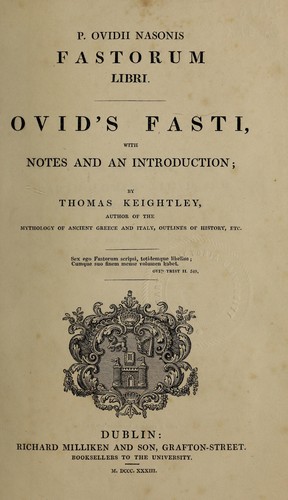
Cover of Fasti

Fasti

Written after he had been banished to the Black Sea city of Tomis by Emperor Augustus, the Fasti is Ovid's last major poetic work. Both a calendar of daily rituals and a witty sequence of stories recounted in a variety of styles, it weaves together tales of gods and citizens together to explore Rome's history, religious beliefs and traditions. It may also be read as a subtle but powerful political manifesto which derides Augustus' attempts to control his subjects by imposing his own mythology upon them: after celebrating the emperor as a Jupiter-on-earth, for example, Ovid deliberately juxtaposes a story showing the king of the gods as a savage rapist. Endlessly playful, this is also a work of integrity and courage, and a superb climax to the life of one of Rome's greatest writers.

Genre
mythologymyths and folklore
Themes
religion
Setting
antiquityancient historyancient romeromecollege
Subject
history
Audience
adult
Length
medium · 360 pages
Form
poetry

Click a tag to see books like this one that share it.

Read it? Sign in to help tag it.

Liked Fasti? Here’s where I’d start.

These suit anyone who liked Fasti. Sign in and mark a few books for picks shaped around your own taste.

  1. Pharsalia: The Civil War Shares poetry, classics, latin
  2. Free onlineFree
    The Georgics Shares poetry, classics, latin
  3. The Sixteen Satires Shares classics, poetry, classical
  4. Leucippe and Clitophon Shares classics, classical, classical literature

“People who read Fasti tend to reach for these next.”

  1. Tusculan Disputations
  2. The Fall of Troy
  3. Menander: The Plays and Fragments
  4. The Satyricon and The Apocolocyntosis

“If you want more of the same (mythology about religion), start with these.”

  1. The Student's Catullus
  2. Catullus. Tibullus. Pervigilium Veneris
  3. The Complete Poems
  4. The Odes of Horace

“If it was the poetry that hooked you, try one of these.”

  1. The Eclogues
  2. Homeric Hymns
  3. The Odes of Horace
  4. Free onlineFree Lays of Ancient Rome

“These start from a similar idea, even if they go somewhere else with it.”

  1. An Introduction to Roman Religion
  2. Son in Sorrow
  3. The Complete Gods and Goddesses of Ancient Egypt
  4. The Unbearable Lightness of Being