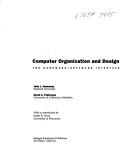
Structured Computer Organization
Sign in to keep track of books you’ve read and want to read.
Completely updated, this book explains how computer designers can follow the structured model to develop efficient hardware and software systems
Read more
New information has been included on UNIX, OS/2, INTEL 8088/80286/80386, Motorola 68000/68020/68030 and RISC machine. The operation of a typical IBM PC clone is now described in detail at the chip level.
Liked Structured Computer Organization? Here’s where I’d start.
These suit anyone who liked Structured Computer Organization. Sign in and mark a few books for picks shaped around your own taste.
-
 Computer Architecture: A Quantitative Approach Shares computer science, computer architecture, programming
 -
 Computer Organization and Architecture: Designing for Performance Shares computer science, programming, computer architecture
 -
 Computer Networking: A Top-Down Approach Shares computer science, programming, it
 -
 Operating System Concepts Shares computer science, programming, computers