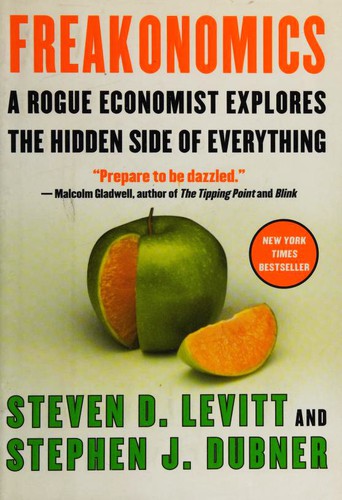
Freakonomics: A Rogue Economist Explores the Hidden Side of Everything
Freakonomics seriesbook 1 of 1 SuperFreakonomics: Global Cooling, Patriotic Prostitutes And Why Suicide Bombers Should Buy Life Insurance(2009) →
Sign in to keep track of books you’ve read and want to read.
Which is more dangerous, a gun or a swimming pool? What do schoolteachers and sumo wrestlers have in common? Why do drug dealers still live with their moms? How much do parents really matter? What kind of impact did Roe v. Wade have on violent crime? Freakonomics will literally redefine the way we view the modern world.
Read more
These may not sound like typical questions for an economist to ask. But Steven D. Levitt is not a typical economist. He is a much heralded scholar who studies the stuff and riddles of everyday life — from cheating and crime to sports and child rearing — and whose conclusions regularly turn the conventional wisdom on its head. He usually begins with a mountain of data and a simple, unasked question. Some of these questions concern life-and-death issues; others have an admittedly freakish quality. Thus the new field of study contained in this book: freakonomics.
Through forceful storytelling and wry insight, Levitt and co-author Stephen J. Dubner show that economics is, at root, the study of incentives — how people get what they want, or need, especially when other people want or need the same thing. In Freakonomics, they set out to explore the hidden side of ... well, everything. The inner workings of a crack gang. The truth about real-estate agents. The myths of campaign finance. The telltale marks of a cheating schoolteacher. The secrets of the Ku Klux Klan.
What unites all these stories is a belief that the modern world, despite a surfeit of obfuscation, complication, and downright deceit, is not impenetrable, is not unknowable, and — if the right questions are asked — is even more intriguing than we think. All it takes is a new way of looking. Steven Levitt, through devilishly clever and clear-eyed thinking, shows how to see through all the clutter.
Freakonomics establishes this unconventional premise: If morality represents how we would like the world to work, then economics represents how it actually does work. It is true that readers of this book will be armed with enough riddles and stories to last a thousand cocktail parties. But Freakonomics can provide more than that. It will literally redefine the way we view the modern world.
Liked Freakonomics: A Rogue Economist Explores the Hidden Side of Everything? Here’s where I’d start.
These suit anyone who liked Freakonomics: A Rogue Economist Explores the Hidden Side of Everything. Sign in and mark a few books for picks shaped around your own taste.
-
 What the Dog Saw and Other Adventures Shares nonfiction, psychology, sociology
 -
 Everybody Lies: Big Data, New Data, and What the Internet Can Tell Us About Who We Really Are Shares nonfiction, science, psychology
 -
 Everything is Obvious: Once You Know the Answer Shares nonfiction, science, psychology
 -
 You May Also Like: Taste in an Age of Endless Choice Shares nonfiction, psychology, science
“People who read Freakonomics: A Rogue Economist Explores the Hidden Side of Everything tend to reach for these next.”

“If you want more of the same (science about politics), start with these.”
“If it was the psychology that hooked you, try one of these.”

“These start from a similar idea, even if they go somewhere else with it.”
- John Maynard Keynes, Vol. 1: Hopes Betrayed, 1883-1920
- Thinking Like an Economist: A Guide to Rational Decision Making
-
 The Why Axis: Hidden Motives and The Undiscovered Economics of Everyday Life
-
 Discover Your Inner Economist: Use Incentives to Fall in Love, Survive Your Next Meeting, and Motivate Your Den tist