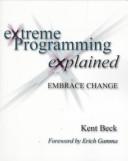
Extreme Programming Explained: Embrace Change (The XP Series)
Sign in to keep track of books you’ve read and want to read.
Software development projects can be fun, productive, and even daring. Yet they can consistently deliver value to a business and remain under control.
Read more
Extreme Programming (XP) was conceived and developed to address the specific needs of software development conducted by small teams in the face of vague and changing requirements. This new lightweight methodology challenges many conventional tenets, including the long-held assumption that the cost of changing a piece of software necessarily rises dramatically over the course of time. XP recognizes that projects have to work to achieve this reduction in cost and exploit the savings once they have been earned.
Fundamentals of XP include:
* Distinguishing between the decisions to be made by business interests and those to be made by project stakeholders.
* Writing unit tests before programming and keeping all of the tests running at all times.
* Integrating and testing the whole system-several times a day. * Producing all software in pairs, two programmers at one screen.
* Starting projects with a simple design that constantly evolves to add needed flexibility and remove unneeded complexity.
* Putting a minimal system into production quickly and growing it in whatever directions prove most valuable.
Why is XP so controversial? Some sacred cows don't make the cut in XP:
* Don't force team members to specialize and become analysts, architects, programmers, testers, and integrators-every XP programmer participates in all of these critical activities every day.
* Don't conduct complete up-front analysis and design-an XP project starts with a quick analysis of the entire system, and XP programmers continue to make analysis and design decisions throughout development.
* Develop infrastructure and frameworks as you develop your application, not up-front-delivering business value is the heartbeat that drives XP projects.
* Don't write and maintain implementation documentation-communication in XP projects occurs face-to-face, or through efficient tests and carefully written code.
You may love XP or you may hate it, but Extreme Programming Explained will force you to take a fresh look at how you develop software.
Liked Extreme Programming Explained: Embrace Change (The XP Series)? Here’s where I’d start.
These suit anyone who liked Extreme Programming Explained: Embrace Change (The XP Series). Sign in and mark a few books for picks shaped around your own taste.
-
 Agile Software Development, Principles, Patterns, and Practices (Alan Apt Series) Shares programming, agile, software development
 -
 Ship It! Shares programming, agile, software development
 -
 Refactoring to Patterns (Addison Wesley Signature Series) Shares programming, tech, software development
 -
 Growing Object-Oriented Software, Guided by Tests Shares programming, tech, software development