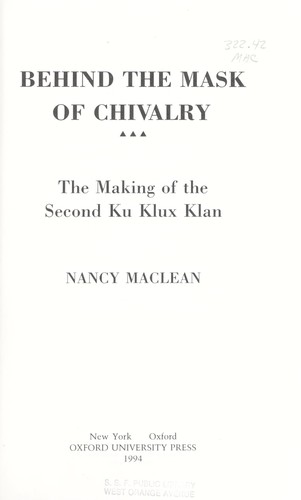
Behind the Mask of Chivalry: The Making of the Second Ku Klux Klan
Sign in to keep track of books you’ve read and want to read.
On Thanksgiving night, 1915, a small band of hooded men gathered atop Stone Mountain, an imposing granite butte just outside Atlanta. With a flag fluttering in the wind beside them, a Bible open to the twelfth chapter of Romans, and a flaming cross to light the night sky above, William Joseph Simmons and his disciples proclaimed themselves the new Knights of the Ku Klux Klan, named for the infamous secret order in which many of their fathers had served after the Civil War. Unsure of their footing in the New South and longing for the provincial, patriarchal world of the past, the men of the second Klan saw themselves as an army in training for a war between the races. They boasted that they had bonded into "an invisible phalanx...to stand as impregnable as a tower against every encroachment upon the white man's liberty...in the white man's country, under the white man's flag."
Read more
Behind the Mask of Chivalrybrings the "invisible phalanx" into broad daylight, culling from history the names, the life stories, and the driving passions of the anonymous Klansmen beneath the white hoods and robes. Using an unusual and rich cache of internal Klan records from Athens, Georgia, to anchor her observations, author Nancy MacLean combines a fine-grained portrait of a local Klan world with a penetrating analysis of the second Klan's ideas and politics nationwide. No other right-wing movement has ever achieved as much power as the Ku Klux Klan of the 1920s, and this book shows how and why it did. MacLean reveals that the movement mobilized its millions of American followers largely through campaigns waged over issues that today would be called "family values": Prohibition violation, premarital sex, lewd movies, anxieties about women's changing roles, and worries over waning parental authority. Neither elites nor "poor white trash," most of the Klan rank and file were married, middle-aged, and middle class. Local meetings, or klonklaves, featured readings of the minutes, plans for recruitment campaigns and Klan barbecues, and distribution of educational materials—Christ and Other Klansmenwas one popular tome. Nonetheless, as mundane as proceedings often were at the local level, crusades over "morals" always operated in the service of the Klan's larger agenda of virulent racial hatred and middle-class revanchism. The men who deplored sex among young people and sought to restore the power of husbands and fathers were also sworn to reclaim the "white man's country," striving to take the vote from blacks and bar immigrants. Comparing the Klan to the European fascist movements that grew out of the crucible of the first World War, MacLean maintains that the remarkable scope and frenzy of the movement reflected less on members' power within their communities than on the challenges to that power posed by African Americans, Jews, Catholics, immigrants, and white women and youth who did not obey the Klan's canon of appropriate conduct. In vigilante terror, the Klan's night riders acted out their movement's brutal determination to maintain inherited hierarchies of race, class, and gender.
Compellingly readable and impeccably researched, The Mask of Chivalryis an unforgettable investigation of a crucial era in American history, and the social conditions, cultural currents, and ordinary men that built this archetypal American reactionary movement.
Liked Behind the Mask of Chivalry: The Making of the Second Ku Klux Klan? Here’s where I’d start.
These suit anyone who liked Behind the Mask of Chivalry: The Making of the Second Ku Klux Klan. Sign in and mark a few books for picks shaped around your own taste.
-
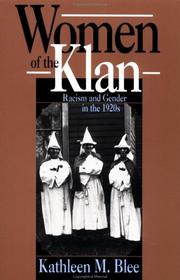 Women of the Klan: Racism and Gender in the 1920s Shares history, nonfiction, race
 -
 The American Intellectual Tradition: Volume I: 1630-1865 Shares history, nonfiction, American history
 -
 Standing at Armageddon: The United States, 1877-1919 Shares history, nonfiction, American history
 -
What America Was Really Like in 1776 Shares history, nonfiction, American history
“People who read Behind the Mask of Chivalry: The Making of the Second Ku Klux Klan tend to reach for these next.”
-
 Making Whiteness: The Culture of Segregation in the South, 1890-1940
-
 The Day Freedom Died: The Colfax Massacre, the Supreme Court and the Betrayal of Reconstruction
-
 Southern Horrors: Women and the Politics of Rape and Lynching
-
 Gender and Jim Crow: Women and the Politics of White Supremacy in North Carolina, 1896-1920