America's Great Depression
Sign in to keep track of books you’ve read and want to read.
Applied Austrian economics doesn't get better than this. Murray N. Rothbard's America's Great Depressionis a staple of modern economic literature and crucial for understanding a pivotal event in American and world history.
Read more
The Mises Institute edition features a new introduction by historian Paul Johnson.
Since it first appeared in 1963, it has been the definitive treatment of the causes of the depression. The book remains canonical today because the debate is still very alive.
Rothbard opens with a theoretical treatment of business cycle theory, showing how an expansive monetary policy generates imbalances between investment and consumption. He proceeds to examine the Fed's policies of the 1920s, demonstrating that it was quite inflationary even if the effects did not show up in the price of goods and services. He showed that the stock market correction was merely one symptom of the investment boom that led inevitably to a bust.
The Great Depression was not a crisis for capitalism but merely an example of the downturn part of the business cycle, which in turn was generated by government intervention in the economy. Had the book appeared in the 1940s, it might have spared the world much grief. Even so, its appearance in 1963 meant that free-market advocates had their first full-scale treatment of this crucial subject. The damage to the intellectual world inflicted by Keynesian- and socialist-style treatments would be limited from that day forward.
Liked America's Great Depression? Here’s where I’d start.
These suit anyone who liked America's Great Depression. Sign in and mark a few books for picks shaped around your own taste.
-
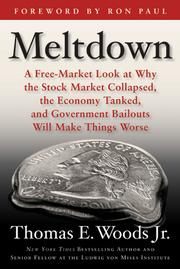 Meltdown: A Free-Market Look at Why the Stock Market Collapsed, the Economy Tanked, and the Government Bailout Will Make Things Worse Shares economics, nonfiction, history
 -
 The Failure of the New Economics Shares economics, nonfiction, austrian economics
 -
 The Theory of Money and Credit Shares economics, nonfiction, libertarian
 -
 GDP: A Brief But Affectionate History Shares economics, history, nonfiction