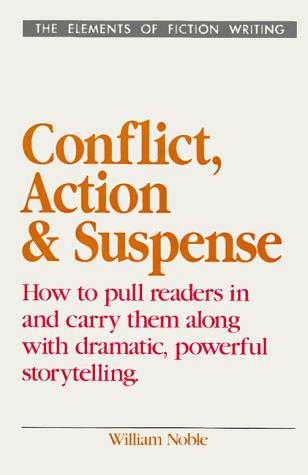
Conflict, Action and Suspense
Elements of Fiction Writing series Setting: How to Create and Sustain a Sharp Sense of Time and Place in Your Fiction(1994) →
Sign in to keep track of books you’ve read and want to read.
What makes a book a page-turner? How do you grab your readers from the start and hold them through the last sentence? How do you make your plot twist and turn and keep the action moving without losing continuity?You do it by generating drama and developing it using conflict, action and suspense. You make your reader burn to know what's going to happen next. You create tension...and build it...to the breaking point.
Read more
William Noble shows you how to intensify that pressure throughout your story. You'll learn exactly what constitutes conflict, action and suspense, how they relate to other important ingredients in your story, and—perhaps most important—how to manipulate them.
Through thorough, step-by-step instruction, you'll learn how to...
* set the stage with techniques and devices that enhance drama.
* introduce suspense from the very beginning of your story.
* build suspense through cliff hangers, dialogue, mood, character development, point of view, subtlety and indirection, and time and place.
* bring all that conflict, action and suspense to a gripping conclusion.
There are all sorts of ways to create tension in your prose—from using adjectives and nouns that drip with imagery to making quick scene cuts and transitions to accelerating the pace. Learn them here. Then use them, and your story will plunge your readers into a river of worry...and the current will carry them to The End.
About the Author
William Noble is the author of several writing books, short fiction and nonfiction pieces. He has taught and lectured about writing at the Breadloaf Writer's Conference and others.
Liked Conflict, Action and Suspense? Here’s where I’d start.
These suit anyone who liked Conflict, Action and Suspense. Sign in and mark a few books for picks shaped around your own taste.
-
 Description & Setting Shares writing, nonfiction, on writing
 -
 The Plot Thickens: 8 Ways to Bring Fiction to Life Shares writing, nonfiction, on writing
 -
 Dialogue: Techniques and exercises for crafting effective dialogue Shares writing, nonfiction, on writing
 -
 Description Shares writing, on writing, nonfiction