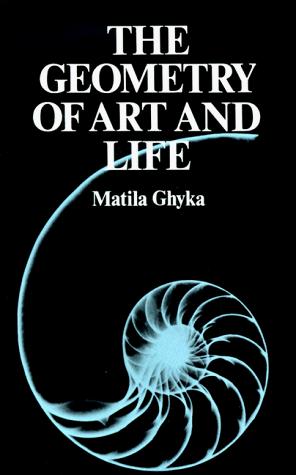
The Geometry of Art and Life
Sign in to keep track of books you’ve read and want to read.
Is everything chaos and chance, or is there order, harmony, and proportion in human life, nature, and the finest art? Can one find a natural aesthetic that corresponds to a universal order? If so, what importance can it have for the scientist, artist, or layman? What is the "true" significance of the triangle, rectangle, spiral, and other geometric shapes? These are but a few of the questions that Professor Matila Ghyka deals with in this fascinating book. The author believes that there are such things as "The Mathematics of Life" and "The Mathematics of Art," and that the two coincide. Using simple mathematical formulas, most as basic as Pythagoras' theorem and requiring only a very limited knowledge of mathematics, Professor Ghyka shows the fascinating relationships between geometry, aesthetics, nature, and the human body.
Read more
Beginning with ideas from Plato, Pythagoras, Archimedes, Ockham, Kepler, and others, the author explores the outlines of an abstract science of space, which includes a theory of proportions, an examination of "the golden section," a study of regular and semi-regular polyhedral, and the interlinking of these various shapes and forms. He then traces the transmission of this spatial science through the Pythagorean tradition and neo-Pythagorism, Greek, and Gothic canons of proportion, the Kabbala, Masonic traditions and symbols, and modern applications in architecture, painting, and decorative art. When we judge a work of art, according to his formulation, we are making it conform to a pattern whose outline is laid down in simple geometrical figures; and it is the analysis of these figures both in art and nature that forms the core of Professor Ghyka's book. He also shows this geometry at work in living organisms. The ample illustrations and figures give concrete examples of the author's analysis: the Great Pyramid and tomb of Rameses IV, the Parthenon, Renaissance paintings and architecture, the work of Seurat, Le Corbusier, and flowers, shells, marine life, the human face, and much more.
For the philosopher, scientist, archaeologist, art historian, biologist, poet, and artist as well as the general reader who wants to understand more about the fascinating properties of numbers and geometry, and their relationship to art and life, this is a thought-provoking book.
Liked The Geometry of Art and Life? Here’s where I’d start.
These suit anyone who liked The Geometry of Art and Life. Sign in and mark a few books for picks shaped around your own taste.