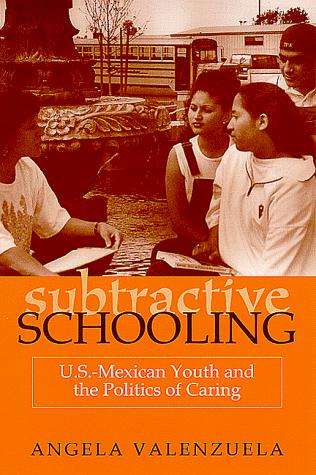
Subtractive Schooling: U.S.-Mexican Youth and the Politics of Caring
Sign in to keep track of books you’ve read and want to read.
Subtractive Schooling provides a framework for understanding the patterns of immigrant achievement and U.S.-born underachievement frequently noted in the literature and observed by the author in her ethnographic account of regular-track youth attending a comprehensive, virtually all-Mexican, inner-city high school in Houston. Valenzuela argues that schools subtract resources from youth in two major ways: firstly by dismissing their definition of education and secondly, through assimilationist policies and practices that minimize their culture and language. A key consequence is the erosion of students' social capital evident in the absence of academically oriented networks among acculturated, U.S.-born youth.
Liked Subtractive Schooling: U.S.-Mexican Youth and the Politics of Caring? Here’s where I’d start.
These suit anyone who liked Subtractive Schooling: U.S.-Mexican Youth and the Politics of Caring. Sign in and mark a few books for picks shaped around your own taste.
-
 Classroom Assessment: What Teachers Need to Know Shares education, nonfiction, teaching
 -
 Adolescents at School: Perspectives on Youth, Identity, and Education Shares education, nonfiction, teaching
 -
 Bad Boys: Public Schools in the Making of Black Masculinity Shares education, nonfiction, teaching
 -
 The End of the Rainbow: How Educating for Happiness - Not Money - Would Transform Our Schools Shares education, nonfiction, teaching