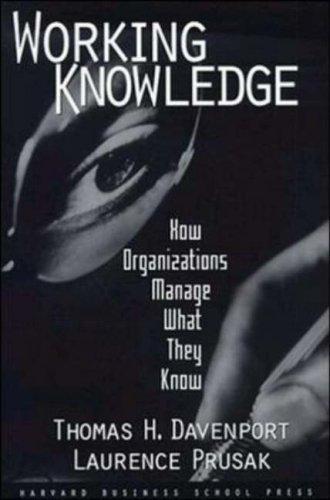
Working Knowledge: How Organizations Manage What They Know
Sign in to keep track of books you’ve read and want to read.
This influential book establishes the enduring vocabulary and concepts in the burgeoning field of knowledge management. It serves as the hands-on resource of choice for companies that recognize knowledge as the only sustainable source of competitive advantage going forward.
Read more
Drawing from their work with more than thirty knowledge-rich firms, Davenport and Prusak—experienced consultants with a track record of success—examine how all types of companies can effectively understand, analyze, measure, and manage their intellectual assets, turning corporate wisdom into market value. They categorize knowledge work into four sequential activities—accessing, generating, embedding, and transferring—and look at the key skills, techniques, and processes of each. While they present a practical approach to cataloging and storing knowledge so that employees can easily leverage it throughout the firm, the authors caution readers on the limits of communications and information technology in managing intellectual capital.
Liked Working Knowledge: How Organizations Manage What They Know? Here’s where I’d start.
These suit anyone who liked Working Knowledge: How Organizations Manage What They Know. Sign in and mark a few books for picks shaped around your own taste.
-
 The Knowledge-Creating Company: How Japanese Companies Create the Dynamics of Innovation Shares knowledge management, business, management
 -
 Enterprise 2.0: How to Manage Social Technologies to Transform Your Organization Shares business, knowledge management, management
 -
Harvard Business Review on Knowledge Management (Harvard Business Review Paperback Series) Shares knowledge management, business, management
-
 Cultivating Communities of Practice: A Guide to Managing Knowledge Shares knowledge management, management, km