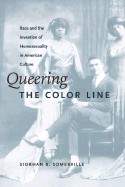
Queering the Color Line: Race and the Invention of Homosexuality in American Culture
Sign in to keep track of books you’ve read and want to read.
Queering the Color Linetransforms previous understandings of how homosexuality was "invented" as a category of identity in the United States beginning in the late nineteenth century. Analyzing a range of sources, including sexology texts, early cinema, and African American literature, Siobhan B. Somerville argues that the emerging understanding of homosexuality depended on the context of the black/white "color line," the dominant system of racial distinction during this period. This book thus critiques and revises tendencies to treat race and sexuality as unrelated categories of analysis, showing instead that race has historically been central to the cultural production of homosexuality.
Read more
At about the same time that the 1896 Supreme Court Plessy v. Fergusondecision hardened the racialized boundary between black and white, prominent trials were drawing the public's attention to emerging categories of sexual identity. Somerville argues that these concurrent developments were not merely parallel but in fact inextricably interrelated and that the discourses of racial and sexual "deviance" were used to reinforce each other's terms. She provides original readings of such texts as Havelock Ellis's late nineteenth-century work on "sexual inversion," the 1914 film A Florida Enchantment, the novels of Pauline E. Hopkins, James Weldon Johnson's Autobiography of an Ex-Coloured Man, and Jean Toomer's fiction and autobiographical writings, including Cane. Through her analyses of these texts and her archival research, Somerville contributes to the growing body of scholarship that focuses on discovering the intersections of gender, race, and sexuality.
Queering the Color Linewill have broad appeal across disciplines including African American studies, gay and lesbian studies, literary criticism, cultural studies, cinema studies, and gender studies.
Liked Queering the Color Line: Race and the Invention of Homosexuality in American Culture? Here’s where I’d start.
These suit anyone who liked Queering the Color Line: Race and the Invention of Homosexuality in American Culture. Sign in and mark a few books for picks shaped around your own taste.
-
 Disidentifications: Queers of Color and the Performance of Politics Shares queer, LGBT, queer theory
 -
 The Trouble with Normal: Sex, Politics, and the Ethics of Queer Life Shares queer, LGBT, queer theory
 -
 In a Queer Time and Place: Transgender Bodies, Subcultural Lives Shares queer, LGBT, queer theory
 -
 Terrorist Assemblages: Homonationalism in Queer Times Shares queer, queer theory, theory
“People who read Queering the Color Line: Race and the Invention of Homosexuality in American Culture tend to reach for these next.”
-
 Aberrations in Black: Toward a Queer of Color Critique
-
 Impossible Desires: Queer Diasporas and South Asian Public Cultures
-
 The Queen of America Goes to Washington City: Essays on Sex and Citizenship
-
 Sexual Politics, Sexual Communities: The Making of a Homosexual Minority in the United States, 1940-1970
“If you want more of the same (history about lgbt), start with these.”


“If it was the queer that hooked you, try one of these.”

“These start from a similar idea, even if they go somewhere else with it.”
-
 Race and the Education of Desire: Foucault's History of Sexuality and the Colonial Order of Things
- Imagining Transgender: An Ethnography of a Category
-
 Black Faces, White Spaces: Reimagining the Relationship of African Americans to the Great Outdoors
-
 Media Culture: Cultural Studies, Identity and Politics Between the Modern and the Post-Modern