What Is Life? with Mind and Matter and Autobiographical Sketches

What Is Life? is a 1944 non-fiction science book written for the lay reader by physicist Erwin Schrodinger. The book was based on a course of public lectures delivered by Schrodinger in February 1943 at Trinity College, Dublin. Schrodinger's lecture focused on one important question: "how can the events in space and time which take place within the spatial boundary of a living organism be accounted for by physics and chemistry?" In the book, Schrodinger introduced the idea of an "aperiodic crystal" that contained genetic information in its configuration of covalent chemical bonds. In the 1950s, this idea stimulated enthusiasm for discovering the genetic molecule and would give both Francis Crick and James Watson initial inspiration in their research.

Setting
European
Audience
adult
Length
short · 184 pages
Form
essays

Click a tag to see books like this one that share it.

Read it? Sign in to help tag it.

Liked What Is Life? with Mind and Matter and Autobiographical Sketches? Here’s where I’d start.

These suit anyone who liked What Is Life? with Mind and Matter and Autobiographical Sketches. Sign in and mark a few books for picks shaped around your own taste.
  1. Chance and Necessity Shares science, philosophy, biology
  2. On Growth and Form Shares science, biology, nonfiction
  3. Physics and Philosophy: The Revolution in Modern Science Shares science, philosophy, physics
  4. Life on the Edge: The Coming of Age of Quantum Biology Shares science, biology, nonfiction

“People who read What Is Life? with Mind and Matter and Autobiographical Sketches tend to reach for these next.”

  1. The Value of Science: Essential Writings of Henri Poincare
  2. One, Two, Three...Infinity: Facts and Speculations of Science
  3. Cybernetics: or the Control and Communication in the Animal and the Machine
  4. The Mathematical Theory of Communication

“If you want more of the same (science about religion), start with these.”

  1. The Visionary Window: A Quantum Physicist's Guide to Enlightenment
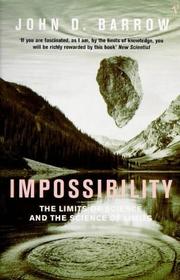
  2. Impossibility: The Limits of Science and the Science of Limits
  3. Science and Method
  4. On Formally Undecidable Propositions of Principia Mathematica and Related Systems

“If it was the philosophy that hooked you, try one of these.”

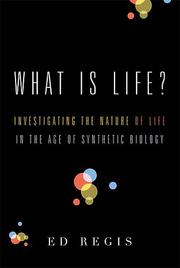
  1. What Is Life?: Investigating the Nature of Life in the Age of Synthetic Biology
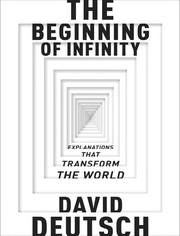
  2. The Beginning of Infinity: Explanations That Transform the World
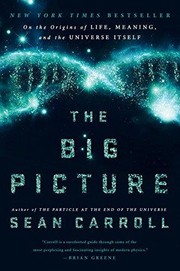
  3. The Big Picture: On the Origins of Life, Meaning, and the Universe Itself
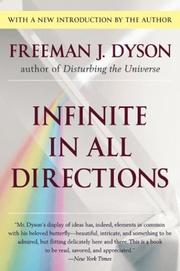
  4. Infinite in All Directions

“These start from a similar idea, even if they go somewhere else with it.”

  1. Eight Lectures on Theoretical Physics
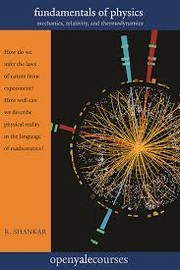
  2. Fundamentals of Physics: Mechanics, Relativity, and Thermodynamics
  3. My Favorite Universe
  4. Black Holes: The Reith Lectures