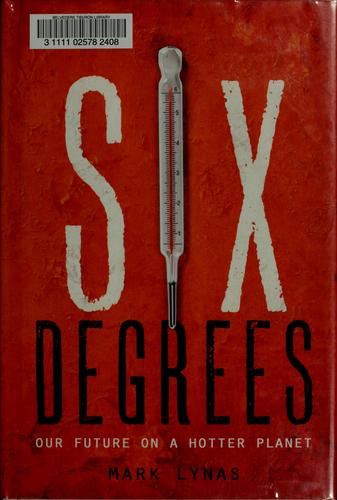
Six Degrees
Sign in to keep track of books you’ve read and want to read.
Possibly the most graphic treatment of global warming that has yet been published, Six Degreesis what readers of Al Gore's best-selling An Inconvenient Truthor Ross Gelbspan's Boiling Pointwill turn to next. Written by the acclaimed author of High Tide, this highly relevant and compelling book uses accessible journalistic prose to distill what environmental scientists portend about the consequences of human pollution for the next hundred years.
Read more
In 2001, the Intergovernmental Panel on Climate Change (IPCC) released a landmark report projecting average global surface temperatures to rise between 1.4 degrees and 5.8 degrees Celsius (roughly 2 to 10 degrees Fahrenheit) by the end of this century. Based on this forecast, author Mark Lynas outlines what to expect from a warming world, degree by degree. At 1 degree Celsius, most coral reefs and many mountain glaciers will be lost. A 3-degree rise would spell the collapse of the Amazon rainforest, disappearance of Greenland's ice sheet, and the creation of deserts across the Midwestern United States and southern Africa. A 6-degree increase would eliminate most life on Earth, including much of humanity.
Based on authoritative scientific articles, the latest computer models, and information about past warm events in Earth history, Six Degreespromises to be an eye-opening warning that humanity will ignore at its peril.
Liked Six Degrees? Here’s where I’d start.
These suit anyone who liked Six Degrees. Sign in and mark a few books for picks shaped around your own taste.
-
 With Speed and Violence: Why Scientists Fear Tipping Points in Climate Change Shares science, environment, climate change
 -
 Storms Of My Grandchildren: The Truth About The Climate Catastrophe And Our Last Chance To Save Humanity Shares science, climate change, environment
 -
 Field Notes from a Catastrophe: Man, Nature, and Climate Change Shares science, nonfiction, environment
 -
 The Weather Makers: How Man Is Changing the Climate and What It Means for Life on Earth Shares science, environment, nonfiction