The Compleat Strategyst: Being a Primer on the Theory of Games of Strategy
Sign in to keep track of books you’ve read and want to read.
When J. D. Williams wrote this entertaining, witty introduction for the nonscientist, game theory was still a somewhat mysterious subject familiar to very few scientists beyond those researchers, like himself, working for the military. Now, over thirty years after its original publication as a Rand Corporation research study, his light-hearted though thoroughly effective primer is the recognized classic introduction to an increasingly applicable discipline. Used by amateurs, professionals, and students throughout the world in the classroom, on the job, and for personal amusement, the book has been through ten printings, and has been translated into at least five languages (including Russian and Japanese).
Read more
Revised, updated, and available for the first time in an inexpensive paperback edition, The Compleat Strategyst is a highly entertaining text essential for anyone interested in this provocative and engaging area of modern mathematics. In fully illustrated chapters complete with everyday examples and word problems, Williams offers readers a working understanding of the possible methods for selecting strategies in a variety of situations, simple to complex. With just a basic understanding of arithmetic, anyone can grasp all necessary aspects of two-, three-, four-, and larger strategy games with two or more sets of inimical interests and a limitless array of zero-sum payoffs.
As research and study continues not only in this new discipline but in the related areas of statistics, probability and behavioral science, understanding of games, decision making, and the development of strategies will be increasingly important. In the areas of economics, sociology, politics, and the military, game theory is sure to have an even wider impact. For students and amateurs fascinated by game theory's implications there is no better, immediately applicable, or more entertaining introduction to the subject than this engaging text by the late J. D. Williams, Professor of Mathematics at Princeton University and a member of the Research Council of The Rand Corporation.
Liked The Compleat Strategyst: Being a Primer on the Theory of Games of Strategy? Here’s where I’d start.
These suit anyone who liked The Compleat Strategyst: Being a Primer on the Theory of Games of Strategy. Sign in and mark a few books for picks shaped around your own taste.
-
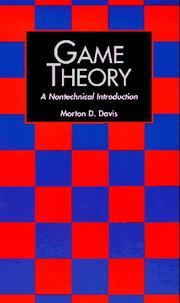 Game Theory: A Nontechnical Introduction Shares game theory, mathematics, math
 -
 Theory of Games and Economic Behavior Shares game theory, mathematics, math
 -
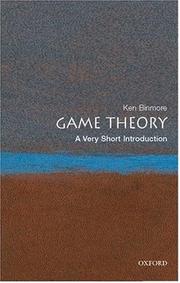 Game Theory: A Very Short Introduction Shares game theory, mathematics, economics
 -
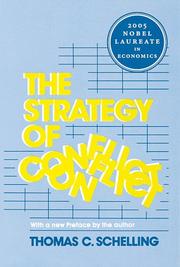 The Strategy of Conflict: With a New Preface by the Author Shares game theory, strategy, economics