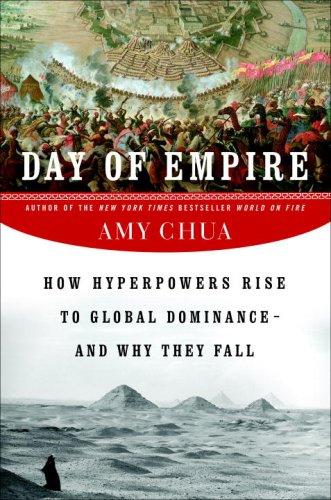
Day of Empire: How Hyperpowers Rise to Global Dominance--and Why They Fall
Sign in to keep track of books you’ve read and want to read.
In a little over two centuries, America has grown from a regional power to a superpower, and to what is today called a hyperpower. But can America retain its position as the world's dominant power, or has it already begun to decline?
Read more
Historians have debated the rise and fall of empires for centuries. To date, however, no one has studied the far rarer phenomenon of hyperpowers—those few societies that amassed such extraordinary military and economic might that they essentially dominated the world.
Now, in this sweeping history of globally dominant empires, bestselling author Amy Chua explains how hyperpowers rise and why they fall. In a series of brilliantly focused chapters, Chua examines history's hyperpowers—Persia, Rome, Tang China, the Mongols, the Dutch, the British, and the United States—and reveals the reasons behind their success, as well as the roots of their ultimate demise.
Chua's unprecedented study reveals a fascinating historical pattern. For all their differences, she argues, every one of these world-dominant powers was, at least by the standards of its time, extraordinarily pluralistic and tolerant. Each one succeeded by harnessing the skills and energies of individuals from very different backgrounds, and by attracting and exploiting highly talented groups that were excluded in other societies. Thus Rome allowed Africans, Spaniards, and Gauls alike to rise to the highest echelons of power, while the "barbarian" Mongols conquered their vast domains only because they practiced an ethnic and religious tolerance unheard of in their time. In contrast,
Nazi Germany and imperial Japan, while wielding great power, failed to attain global dominance as a direct result of their racial and religious intolerance.
But Chua also uncovers a great historical irony: in virtually every instance, multicultural tolerance eventually sowed the seeds of decline, and diversity became a liability, triggering conflict, hatred, and violence.
The United States is the quintessential example of a power that rose to global dominance through tolerance and diversity. The secret to America's success has always been its unsurpassed ability to attract enterprising immigrants. Today, however, concerns about outsourcing and uncontrolled illegal immigration are producing a backlash against our tradition of cultural openness. Has America finally reached a "tipping point"? Have we gone too far in the direction of diversity and tolerance to maintain cohesion and unity? Will we be overtaken by rising powers like China, the EU or even India?
Chua shows why American power may have already exceeded its limits and why it may be in our interest to retreat from our go-it-alone approach and promote a new multilateralism in both domestic and foreign affairs.
Liked Day of Empire: How Hyperpowers Rise to Global Dominance--and Why They Fall? Here’s where I’d start.
These suit anyone who liked Day of Empire: How Hyperpowers Rise to Global Dominance--and Why They Fall. Sign in and mark a few books for picks shaped around your own taste.
-
 Civilization: The West and the Rest Shares history, nonfiction, economics
 -
 Why the West Rules—for Now: The Patterns of History, and What They Reveal About the Future Shares history, nonfiction, economics
 -
 Untapped: The Scramble for Africa's Oil Shares nonfiction, history, politics
 -
 Merchant, Soldier, Sage: A New History of Power Shares history, nonfiction, economics