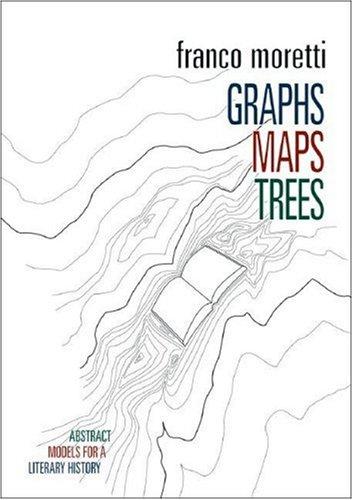
Cover of Graphs, Maps, Trees: Abstract Models for a Literary History

Graphs, Maps, Trees: Abstract Models for a Literary History

Professor Franco Moretti argues heretically that literature scholars should stop reading books and start counting, graphing, and mapping them instead. He insists that such a move could bring new luster to a tired field, one that in some respects is among "the most backwards disciplines in the academy." Literary study, he argues, has been random and unsystematic. For any given period scholars focus on a select group of a mere few hundred texts: the canon. As a result, they have allowed a narrow distorting slice of history to pass for the total picture.

Read more

Moretti offers bar charts, maps, and time lines instead, developing the idea of "distant reading," set forth in his path-breaking essay "Conjectures on World Literature," into a full-blown experiment in literary historiography, where the canon disappears into the larger literary system. Charting entire genres—the epistolary, the gothic, and the historical novel—as well as the literary output of countries such as Japan, Italy, Spain, and Nigeria, he shows how literary history looks significantly different from what is commonly supposed and how the concept of aesthetic form can be radically redefined.

Audience
adult
Length
short · 119 pages

Click a tag to see books like this one that share it. Point at it (on a phone, tap it) for less of it instead.

Read it? Sign in to help tag it.

Liked Graphs, Maps, Trees: Abstract Models for a Literary History? Here’s where I’d start.

These suit anyone who liked Graphs, Maps, Trees: Abstract Models for a Literary History. Sign in and mark a few books for picks shaped around your own taste.
  1. Narrative Discourse Shares nonfiction
  2. War Games: The Story of Aid and War in Modern Times Shares society, nonfiction
  3. Narratology: Introduction to the Theory of Narrative Shares nonfiction
  4. Isn't That Rich?: Life Among the 1 Percent Shares society, nonfiction

“People who read Graphs, Maps, Trees: Abstract Models for a Literary History tend to reach for these next.”

  1. The Theory of the Novel
  2. The Content of the Form: Narrative Discourse and Historical Representation
  3. Reading for the Plot: Design and Intention in Narrative
  4. The Rhetoric of Fiction

“If you want more of the same, start with these.”

  1. Organizing Schools for Improvement: Lessons from Chicago
  2. Core Syntax: A Minimalist Approach
  3. Meaning in Interaction: An Introduction to Pragmatics
  4. Linguistics: An Introduction

“If it was the society that hooked you, try one of these.”

  1. The Wish for Kings: Democracy at Bay
  2. The Internet Police: How Crime Went Online, and the Cops Followed
  3. The Selfish Society: How We All Forgot to Love One Another and Made Money Instead
  4. The Selfish Capitalist: Origins of Affluenza

“These start from a similar idea, even if they go somewhere else with it.”

  1. 50 Literature Ideas You Really Need to Know
  2. The Encyclopedia of the Middle Ages
  3. The Rise and Fall of English: Reconstructing English as a Discipline
  4. The Field of Cultural Production