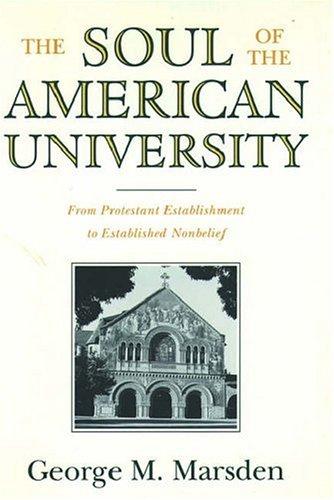
The Soul of the American University: From Protestant Establishment to Established Nonbelief
Sign in to keep track of books you’ve read and want to read.
Only a century ago, almost all stateuniversities held compulsory chapel services, and some required Sunday church attendance as well. In fact, state-sponsored chapel services were commonplace until the World War II era, and as late as the 1950s, it was not unusual for leading schools to refer to themselves as "Christian" institutions. Today, the once pervasive influence of religion in the intellectual and cultural life of America's preeminent colleges and universities has all but vanished. In The Soul of the American University, Marsden explores how, and why, these dramatic changes occurred.
Read more
Far from a lament for a lost golden age when mainline Protestants ruled American education, The Soul of the American Universityoffers a penetrating critique of that era, surveying the role of Protestantism in higher education from the founding of Harvard in the 1630s through the collapse of the WASP establishment in the 1960s. Marsden tells the stories of many of our pace-setting universities at defining moments in their histories, including Harvard, Yale, Princeton, the University of Michigan, Johns Hopkins, the University of California at Berkeley, and the University of Chicago. He recreates the religious feuds that accompanied Yale's transition from a flagship evangelical college to a university, and the dramatic debate over the place of religion in higher education between Harvard's President Charles Eliot and Princeton's President James McCosh. Marsden's analysis ranges from debates over Darwinism and higher critics of the Bible, to the roles of government and wealthy contributors, the impact of changing student mores, and even the religious functions of college football. He argues persuasively that the values of "liberalism" and "tolerance" that the establishment championed and used to marginalize Christian fundamentalism and Roman Catholicism eventually and perhaps inevitably led to its own disappearance from the educational milieu, as nonsectarian came to mean exclusively secular.
While the largely voluntary disestablishment of religion may appear in many respects commendable, Marsden believes that it has nonetheless led to the infringement of the free exercise of religion in most of academic life. In effect, nonbelief has been established as the only valid academic perspective. In a provocative final chapter, Marsden spells out his own prescription for change, arguing that just as the academy has made room for feminist and multicultural perspectives, so should there be room once again for traditional religious viewpoints. A thoughtful blend of historical narrative and searching analysis, The Soul of the American Universityexemplifies what it advocates: that religious perspectives can provide a legitimate contribution to the highest level of scholarship.
Liked The Soul of the American University: From Protestant Establishment to Established Nonbelief? Here’s where I’d start.
These suit anyone who liked The Soul of the American University: From Protestant Establishment to Established Nonbelief. Sign in and mark a few books for picks shaped around your own taste.
-
 The Marketplace of Ideas: Reform and Resistance in the American University Shares education, higher education, history
 -
 The Idea of a Christian College Shares education, higher education, theology
 -
 College: What it Was, Is, and Should Be Shares education, higher education, academia
 -
 The Civil War as a Theological Crisis Shares history, theology, christianity
“People who read The Soul of the American University: From Protestant Establishment to Established Nonbelief tend to reach for these next.”

“If you want more of the same (history about religion), start with these.”
-
 More Than Dates and Dead People: Recovering a Christian View of History
-
 American Education: A History with the McGraw-Hill Foundations of Education Timeline
-
 In the Company of Educated Women: A History of Women and Higher Education in America
-
 Pillars of the Republic: Common Schools and American Society, 1780-1860