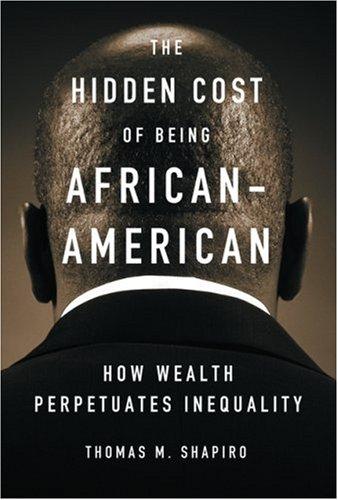
The Hidden Cost of Being African American: How Wealth Perpetuates Inequality
Sign in to keep track of books you’ve read and want to read.
Over the past three decades, racial prejudice in America has declined significantly and many African American families have seen a steady rise in employment and annual income. But alongside these encouraging signs, Thomas Shapiro argues in The Hidden Cost of Being African American, fundamental levels of racial inequality persist, particularly in the area of asset accumulation—inheritance, savings accounts, stocks, bonds, home equity, and other investments. Shapiro reveals how the lack of these family assets along with continuing racial discrimination in crucial areas like homeownership dramatically impact the everyday lives of many black families, reversing gains earned in schools and on jobs, and perpetuating the cycle of poverty in which far too many find themselves trapped.
Read more
Shapiro uses a combination of in-depth interviews with almost 200 families from Los Angeles, Boston, and St. Louis, and national survey data with 10,000 families to show how racial inequality is transmitted across generations. We see how those families with private wealth are able to move up from generation to generation, relocating to safer communities with better schools and passing along the accompanying advantages to their children. At the same time those without significant wealth remain trapped in communities that don't allow them to move up, no matter how hard they work. Shapiro challenges white middle class families to consider how the privileges that wealth brings not only improve their own chances but also hold back people who don't have them. This "wealthfare" is a legacy of inequality that, if unchanged, will project social injustice far into the future.
Showing that over half of black families fall below the asset poverty line at the beginning of the new century, The Hidden Cost of Being African Americanwill challenge all Americans to reconsider what must be done to end racial inequality.
Liked The Hidden Cost of Being African American: How Wealth Perpetuates Inequality? Here’s where I’d start.
These suit anyone who liked The Hidden Cost of Being African American: How Wealth Perpetuates Inequality. Sign in and mark a few books for picks shaped around your own taste.
-
 Racism without Racists: Color-Blind Racism and the Persistence of Racial Inequality in the United States Shares race, sociology, nonfiction
 -
 Affirmative Action: Racial Preference in Black and White Shares race, nonfiction, sociology
 -
 Our Black Year: One Family's Quest to Buy Black in America's Racially Divided Economy Shares race, nonfiction, sociology
 -
 The Anatomy of Racial Inequality Shares race, sociology, nonfiction