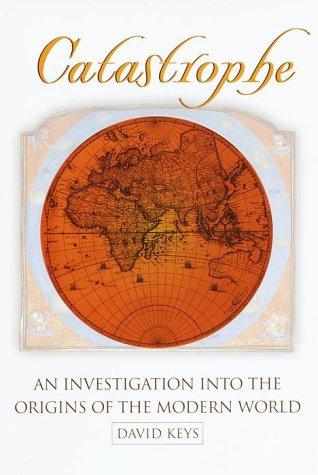
Catastrophe: An Investigation into the Origins of Modern Civilization
Sign in to keep track of books you’ve read and want to read.
It was a catastrophe without precedent in recorded history: for months on end, starting in A.D. 535, a strange, dusky haze robbed much of the earth of normal sunlight. Crops failed in Asia and the Middle East as global weather patterns radically altered. Bubonic plague, exploding out of Africa, wiped out entire populations in Europe. Flood and drought brought ancient cultures to the brink of collapse. In a matter of decades, the old order died and a new world—essentially the modern world as we know it today—began to emerge.
Read more
In this fascinating, groundbreaking, totally accessible book, archaeological journalist David Keys dramatically reconstructs the global chain of revolutions that began in the catastrophe of A.D. 535, then offers a definitive explanation of how and why this cataclysm occurred on that momentous day centuries ago.
The Roman Empire, the greatest power in Europe and the Middle East for centuries, lost half its territory in the century following the catastrophe. During the exact same period, the ancient southern Chinese state, weakened by economic turmoil, succumbed to invaders from the north, and a single unified China was born. Meanwhile, as restless tribes swept down from the central Asian steppes, a new religion known as Islam spread through the Middle East. As Keys demonstrates with compelling originality and authoritative research, these were not isolated upheavals but linked events arising from the same cause and rippling around the world like an enormous tidal wave.
Keys's narrative circles the globe as he identifies the eerie fallout from the months of darkness: unprecedented drought in Central America, a strange yellow dust drifting like snow over eastern Asia, prolonged famine, and the hideous pandemic of the bubonic plague. With a superb command of ancient literatures and historical records, Keys makes hitherto unrecognized connections between the "wasteland" that overspread the British countryside and the fall of the great pyramid-building Teotihuacan civilization in Mexico, between a little-known "Jewish empire" in Eastern Europe and the rise of the Japanese nation-state, between storms in France and pestilence in Ireland.
In the book's final chapters, Keys delves into the mystery at the heart of this global catastrophe: Why did it happen? The answer, at once surprising and definitive, holds chilling implications for our own precarious geopolitical future. Wide-ranging in its scholarship, written with flair and passion, filled with original insights, Catastrophe is a superb synthesis of history, science, and cultural interpretation.
Liked Catastrophe: An Investigation into the Origins of Modern Civilization? Here’s where I’d start.
These suit anyone who liked Catastrophe: An Investigation into the Origins of Modern Civilization. Sign in and mark a few books for picks shaped around your own taste.
-
 The Long Summer: How Climate Changed Civilization Shares science, nonfiction, history
 -
 Britain BC: Life in Britain and Ireland Before the Romans Shares history, nonfiction, archaeology
 -
 Krakatoa: The Day the World Exploded Shares nonfiction, science, history
 -
 A Crack in the Edge of the World Shares nonfiction, history, science