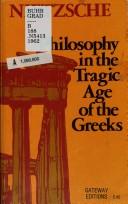
Philosophy in the Tragic Age of the Greeks
Sign in to keep track of books you’ve read and want to read.
For Nietzsche the Age of Greek Tragedy was indeed a tragic age. He saw in it the rise and climax of values so dear to him that their subsequent drop into catastrophe (in the person of Socrates - Plato) was clearly foreshadowed as though these were events taking place in the theater.
Read more
And so in this work, unpublished in his own day but written at the same time that his The Birth of Tragedyhad so outraged the German professorate as to imperil his own academic career, his most deeply felt task was one of education. He wanted to present the culture of the Greeks as a paradigm to his young German contemporaries who might thus be persuaded to work toward a state of culture of their own; a state where Nietzsche found sorely missing.
Liked Philosophy in the Tragic Age of the Greeks? Here’s where I’d start.
These suit anyone who liked Philosophy in the Tragic Age of the Greeks. Sign in and mark a few books for picks shaped around your own taste.



“People who read Philosophy in the Tragic Age of the Greeks tend to reach for these next.”
-
 The Oxford History of the Classical World
-
 The Fragility of Goodness: Luck and Ethics in Greek Tragedy and Philosophy
-
 The Government of Self and Others: Lectures at the Collège de France, 1982–1983
-
 A History of Philosophy, Vol 9: Modern Philosophy, from the French Revolution to Sartre, Camus, and Levi-Strauss