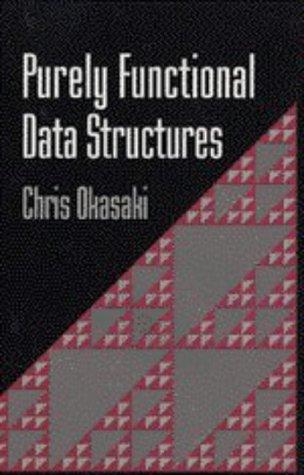
Purely Functional Data Structures
Sign in to keep track of books you’ve read and want to read.
Most books on data structures assume an imperative language such as C or C++. However, data structures for these languages do not always translate well to functional languages such as Standard ML, Haskell, or Scheme. This book describes data structures from the point of view of functional languages, with examples, and presents design techniques that allow programmers to develop their own functional data structures. The author includes both classical data structures, such as red-black trees and binomial queues, and a host of new data structures developed exclusively for functional languages. All source code is given in Standard ML and Haskell, and most of the programs are easily adaptable to other functional languages. This handy reference for professional programmers working with functional languages can also be used as a tutorial or for self-study.
Liked Purely Functional Data Structures? Here’s where I’d start.
These suit anyone who liked Purely Functional Data Structures. Sign in and mark a few books for picks shaped around your own taste.
-
 Pearls of Functional Algorithm Design Shares programming, computer science, functional programming
 -
 Types and Programming Languages Shares programming, computer science, cs
 -
 An Introduction to Functional Programming Through Lambda Calculus Shares programming, computer science, functional programming
 -
 Learn You a Haskell for Great Good! Shares programming, computer science, functional programming