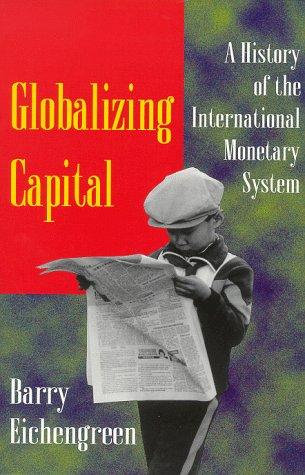
Globalizing Capital: A History of the International Monetary System
Sign in to keep track of books you’ve read and want to read.
"Eichengreen's purpose is to provide a brief history of the international monetary system. In this, he succeeds magnificently. Globalizing Capital will become a classic."—Douglas Irwin, University of ChicagoThe importance of the international monetary system is clearly evident in daily news stories about fluctuating currencies and in dramatic events such as the recent reversals in the Mexican economy. It has become increasingly apparent that one cannot understand the international economy without knowing how its monetary system operates. Now Barry Eichengreen presents a brief, lucid book that tells the story of the international financial system over the past 150 years. Globalizing Capital is intended not only for economists but also for a general audience of historians, political scientists, professionals in government and business, and anyone with a broad interest in international economic and political relations. Eichengreen's work demonstrates that insights into the international monetary system and effective principles for governing it can result only if it is seen a historical phenomenon extending from the gold standard period to interwar instability, then to Bretton Woods, and finally to the post-1973 period of fluctuating currencies.Eichengreen analyzes the shift from pegged to floating exchange rates in the 1970s and ascribes that change to the growing capital mobility that has made pegged rates difficult to maintain. However, he shows that capital mobility was also high prior to World War I, yet this did not prevent the maintenance of fixed exchange rates. What was critical for the successful maintenance of fixed exchange rates during that period was the fact that governmentswere relatively insulated from democratic politics and thus from pressure to trade off exchange rate stability for other goals, such as the reduction of unemployment. Today pegging exchange rates would require very radical reforms of a sort that governments are understandably reluctant to embrace. The implication seems undeniable: floating rates are here to stay.
Liked Globalizing Capital: A History of the International Monetary System? Here’s where I’d start.
These suit anyone who liked Globalizing Capital: A History of the International Monetary System. Sign in and mark a few books for picks shaped around your own taste.
-
 GDP: A Brief But Affectionate History Shares economics, nonfiction, history
 -
 Global Capitalism: Its Fall and Rise in the Twentieth Century Shares economics, economic history, history
 -
 A Farewell to Alms: A Brief Economic History of the World Shares economics, history, nonfiction
 -
 The Chastening: Inside The Crisis That Rocked The Global Financial System And Humbled The Imf Shares economics, nonfiction, econ