Paris 1919: Six Months That Changed the World
Sign in to keep track of books you’ve read and want to read.
'Without question, Margaret MacMillan's Paris 1919 is the most honest and engaging history ever written about those fateful months after World War I when the maps of Europe were redrawn. Brimming with lucid analysis, elegant character sketches, and geopolitical pathos, it is essential reading.'
Read more
Between January and July 1919, after "the war to end all wars," men and women from around the world converged on Paris to shape the peace. Center stage, for the first time in history, was an American president, Woodrow Wilson, who with his Fourteen Points seemed to promise to so many people the fulfillment of their dreams. Stern, intransigent, impatient when it came to security concerns and wildly idealistic in his dream of a League of Nations that would resolve all future conflict peacefully, Wilson is only one of the larger-than-life characters who fill the pages of this extraordinary book. David Lloyd George, the gregarious and wily British prime minister, brought Winston Churchill and John Maynard Keynes. Lawrence of Arabia joined the Arab delegation. Ho Chi Minh, a kitchen assistant at the Ritz, submitted a petition for an independent Vietnam.
For six months, Paris was effectively the center of the world as the peacemakers carved up bankrupt empires and created new countries. This book brings to life the personalities, ideals, and prejudices of the men who shaped the settlement. They pushed Russia to the sidelines, alienated China, and dismissed the Arabs. They struggled with the problems of Kosovo, of the Kurds, and of a homeland for the Jews.
The peacemakers, so it has been said, failed dismally; above all they failed to prevent another war. Margaret MacMillan argues that they have unfairly been made the scapegoats for the mistakes of those who came later. She refutes received ideas about the path from Versailles to World War II and debunks the widely accepted notion that reparations imposed on the Germans were in large part responsible for the Second World War.
A landmark work of narrative history, Paris 1919 is the first full-scale treatment of the Peace Conference in more than twenty-five years. It offers a scintillating view of those dramatic and fateful days when much of the modern world was sketched out, when countries were created—Iraq, Yugoslavia, Israel—whose troubles haunt us still.
Winner of the Samuel Johnson Prize, the PEN Hessell Tiltman Prize and the Duff Cooper Prize
Liked Paris 1919: Six Months That Changed the World? Here’s where I’d start.
These suit anyone who liked Paris 1919: Six Months That Changed the World. Sign in and mark a few books for picks shaped around your own taste.
-
 Europe's Last Summer: Who Started the Great War in 1914? Shares history, nonfiction, wwi
 -
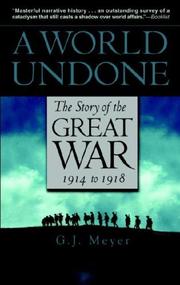 A World Undone: The Story of the Great War, 1914 to 1918 Shares history, nonfiction, wwi
 -
 The Vertigo Years: Europe 1900-1914 Shares history, nonfiction, european history
 -
 To End All Wars: A Story of Loyalty and Rebellion, 1914-1918 Shares history, nonfiction, wwi