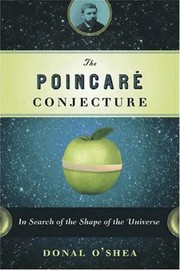
Poincare's Prize: The Hundred-Year Quest to Solve One of Math's Greatest Puzzles
Sign in to keep track of books you’ve read and want to read.
With a reclusive and eccentric hero, dramatic turns, and a million-dollar payoff, Poincare's Prize is the stuff of great fiction. Amazingly, the story unveiled in it is true.
Read more
In the world of math, the Poincare Conjecture was a holy grail. Decade after decade the theorem that informs how we understand the shape of the universe defied every effort to prove it. Now, after more than a century, an eccentric Russian recluse has found the solution to one of the seven greatest math problems of our time, earning the right to claim the first one-million-dollar Millennium math prize.
George Szpiro begins his masterfully told story in 1904 when Frenchman Henri Poincare formulated a conjecture about a seemingly simple problem. Imagine an ant crawling around on a large surface. How would it know whether the surface is a flat plane, a round sphere, or a bagel- shaped object? The ant would need to lift off into space to observe the object. How could you prove the shape was spherical without actually seeing it? Simply, this is what Poincare sought to solve.
In fact, Poincare thought he had solved it back at the turn of the twentieth century, but soon realized his mistake. After four more years' work, he gave up. Across the generations from China to Texas, great minds stalked the solution in the wilds of higher dimensions. Among them was Grigory Perelman, a mysterious Russian who seems to have stepped out of a Dostoyevsky novel. Living in near poverty with his mother, he has refused all prizes and academic appointments, and rarely talks to anyone, including fellow mathematicians. It seemed he had lost the race in 2002, when the conjecture was widely but, again, falsely reported as solved. A year later, Perelman dropped three papers onto the Internet that not only proved the Poincare Conjecture but enlightened the universe of higher dimensions, solving an array of even more mind-bending math with implications that will take an age to unravel. After years of review, his proof has just won him a Fields Medal—the 'Nobel of math'—awarded only once every four years. With no interest in fame, he refused to attend the ceremony, did not accept the medal, and stayed home to watch television.
Perelman is a St. Petersburg hero, devoted to an ascetic life of the mind. The story of the enigma in the shape of space that he cracked is part history, part math, and a fascinating tale of the most abstract kind of creativity.
Liked Poincare's Prize: The Hundred-Year Quest to Solve One of Math's Greatest Puzzles? Here’s where I’d start.
These suit anyone who liked Poincare's Prize: The Hundred-Year Quest to Solve One of Math's Greatest Puzzles. Sign in and mark a few books for picks shaped around your own taste.
-
 The Calculus Wars: Newton, Leibniz, and the Greatest Mathematical Clash of All Time Shares math, mathematics, nonfiction
 -
 The Little Book of Mathematical Principles, Theories, & Things Shares math, nonfiction, mathematics
 -
 Group Theory in the Bedroom, and Other Mathematical Diversions Shares math, nonfiction, mathematics
 -
 200% of Nothing Shares math, science, nonfiction
“People who read Poincare's Prize: The Hundred-Year Quest to Solve One of Math's Greatest Puzzles tend to reach for these next.”

“If you want more of the same (science), start with these.”


“If it was the math that hooked you, try one of these.”
-
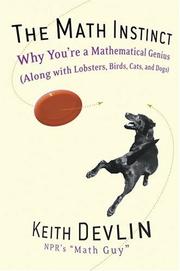 The Math Instinct: Why You're a Mathematical Genius
-
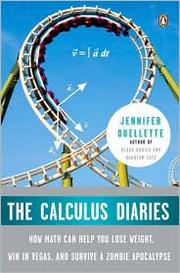 The Calculus Diaries: How Math Can Help You Lose Weight, Win in Vegas, and Survive a Zombie Apocalypse
-
 How to Bake Pi: An Edible Exploration of the Mathematics of Mathematics
-
 Multivariable Calculus: Early Transcendentals (with Tools for Enriching Calculus, Video CD-ROM, Ilrn Homework, and Personal Tutor) [With CDROM]