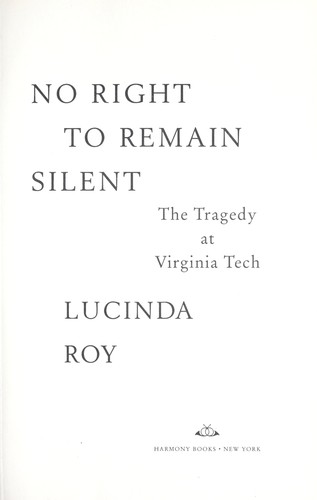
No Right to Remain Silent: The Tragedy at Virginia Tech
Sign in to keep track of books you’ve read and want to read.
The world watched in horror in April 2007 when Virginia Tech student Seung-Hui Cho went on a killing rampage that resulted in the deaths of thirty-two students and faculty members before he ended his own life. Former Virginia Tech English department chair and distinguished professor Lucinda Roy saw the tragedy unfold on the TV screen in her home and had a terrible realization. Cho was the student she had struggled to get to know—the loner who found speech torturous. After he had been formally asked to leave a poetry class in which he had shared incendiary work that seemed directed at his classmates and teacher, Roy began the difficult task of working one-on-one with him in a poetry tutorial. During those months, a year and a half before the massacre, Roy came to realize that Cho was more than just a disgruntled young adult experimenting with poetic license; he was, in her opinion, seriously depressed and in urgent need of intervention. But when Roy approached campus counseling as well as others in the university about Cho, she was repeatedly told that they could not intervene unless a student sought counseling voluntarily. Eventually, Roy's efforts to persuade Cho to seek help worked. Unbelievably, on the three occasions he contacted the counseling center staff, he did not receive a comprehensive evaluation by them—a startling discovery Roy learned about after Cho's death. More revelations were to follow. After responding to questions from the media and handing over information to law enforcement as instructed by Virginia Tech, Roy was shunned by the administration. Papers documenting Cho's interactions with campus counseling were lost. The university was suddenly on the defensive. Was the university, in fact, partially responsible for the tragedy because of the bureaucratic red tape involved in obtaining assistance for students with mental illness, or was it just, like many colleges, woefully underfunded and therefore underequipped to respond to such cases? Who was Seung-Hui Cho? Was he fully protected under the constitutional right to freedom of speech, or did his writing and behavior present serious potential threats that should have resulted in immediate intervention? How can we balance students' individual freedom with the need to protect the community? These are the questions that have haunted Roy since that terrible day. No Right to Remain Silent is one teacher's cri de coeur—her dire warning that given the same situation today, two years later, the ending would be no less terrifying and no less tragic.From the Hardcover edition.
Liked No Right to Remain Silent: The Tragedy at Virginia Tech? Here’s where I’d start.
These suit anyone who liked No Right to Remain Silent: The Tragedy at Virginia Tech. Sign in and mark a few books for picks shaped around your own taste.
-
 Lethal Passage: The Story of a Gun Shares nonfiction, true crime, history
 -
 Facing Down Evil Shares nonfiction, true crime, history
 -
 Unlearning Liberty: Campus Censorship and the End of American Debate Shares nonfiction, education, history
 -
 April 16th: Virginia Tech Remembers Shares nonfiction, true crime, history
“People who read No Right to Remain Silent: The Tragedy at Virginia Tech tend to reach for these next.”



“If you want more of the same (true crime), start with these.”
-
 American Fire: Love, Arson, and Life in a Vanishing Land
-
 A Woman Doing Life: Notes from a Prison for Women
-
 The Little Bookstore of Big Stone Gap: A Memoir of Friendship, Community, and the Uncommon Pleasure of a Good Book
-
 Truevine: Two Brothers, a Kidnapping, and a Mother's Quest: A True Story of the Jim Crow South
“If it was the crime that hooked you, try one of these.”
-
 Heist: The Oddball Crew Behind the $17 Million Loomis Fargo Theft
-
 Incendiary: The Psychiatrist, the Mad Bomber and the Invention of Criminal Profiling
-
 A Death in Texas: A Story of Race, Murder and a Small Town's Struggle for Redemption
-
 The Last Good Heist: The Inside Story of the Biggest Single Payday in the Criminal History of the Northeast