From Old Notebooks
Sign in to keep track of books you’ve read and want to read.
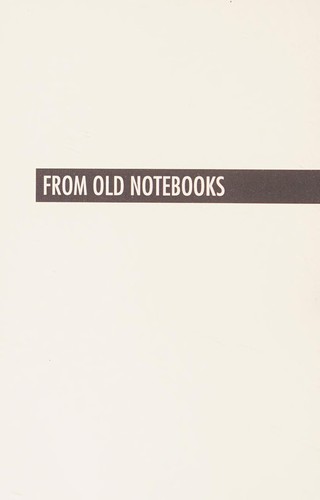
From Old Notebooksis a memoir, a novel, a poem, an essay — a self-styled memoivel— which exemplifies how love of language and literature enriches our lives, and explores, often with great humor, the many pitfalls confronting a young writer and father on his journey to maturity. Each entry in From Old Notebooksis literally that — an idea written in a writer's draftbook. Within this unconventional format, Lavender-Smith is able to tell us the story of his life while ruminating on subjects ranging from fatherhood to philosophy, art, football, music, politics, TV, teaching, fear of death, and everything in between. In the process, Lavender-Smith lays bare the day-to-day trials and tribulations of an artist confronted by the pressures of culture, family, writing, and, simply, being. Witty, original, poignant and deeply insightful, From Old Notebooksis a coming-of-age story, an ode to writing and reading, to living and loving — a celebration of "human thought in all its glory, all its mundanity."
Read more
"The great tradition of modern philosophy and letters, from Nietzsche and Artaud to Deleuze and Houellebecq, has taught us this much: maintaining the old grammars, figures and style of humanist narrative will never allow us to think. While sustaining a beauty of textual expression Lavender-Smith has nevertheless created a new genre of literature and a new mode and style of thought. This work is at once intellectually compelling and creatively breathtaking. This is a book to be read slowly, carefully and with thoughtful pleasure." CLAIRE COLEBROOK, author of Irony in the Work of Philosophyand Milton, Evil and Literary History
"Unapologetically honest, dazzling introspective, meticulous and charming, Evan Lavender-Smith's From Old Notebookspresents us with both the minutiae and macrutiae of a lived life - both the sacred and the profane, the mundane and the miraculous — and interrogates genre so as to interrogate why we live and why we die. His writing commands us to eavesdrop, and we do so ravenously." JENNY BOULLY, author of The Body: An Essayand The Book of Beginnings and Endings
"Finally a conceptual art that is thoroughly literary. This is not a registering in language of various perverse tasks like copying an entire issue of The New York Times. Rather Lavender-Smith's fictions ask us to project, reflect on, and even enjoy the bizarre ways that fictions pervade our world — recalled simply by mention, without the necessity of their being developed. I especially like his projected plots because the reader cannot know if he or she could easily complete them or find it impossible to have much to say at all. Perhaps in the long run those are both the same states, and what matters most about our fictions is that they are so always already complete that they also seem inexhaustible." CHARLES ALTIERI, author of Postmodernisms Now: Essays on Contemporaneity in the Artsand The Particulars of Rapture: An Aesthetics of the Affects
"Scenes, plots for possible stories and novels. Whimsical, fearful, lusty, philosophical, and scatological notes on books, moods, dreams, domestic events. Carrying this book around, the reader will look into it from time to time to jiggle quiescent corners of the brain." ALPHONSO LINGIS, author of The Community of Those Who Have Nothing in Commonand The First Person Singular
"'Novel in which the verb to beand all inflections thereof appear italicized in every instance.' 'Story about a mother who develops an allergic reaction to her kids.' 'Monologue spoken by an aging pianist-composer, based on Prokofiev, beginning with the following sentence: My fingers have grown very tired.' This is not 'stream of consciousness,' this is jet stream of consciousness. The mind above itself looking into itself, into fantasy, imagination, longing, and fear as if from a great and bemused but wary distance. If, as Baudelaire has written, the philosopher is the one who has 'acquired by habit a power of rapid self-division and thus of assisting as a disinterested spectator at the phenomena of his own ego,' then Evan Lavender-Smith is that philosopher — writing with an intense wit, an open vulnerability, and an intricately layered intelligence — layered like a cake and layered like a Dantean vision: sweet, rich, terrifying, demonic. An outrageously smart and seriously playful/prayerful book. Read it." JULIE CARR, author of Mead: An Epithalamionand 100 Notes on Violence
"Like an atonal musical composition, Evan Lavender-Smith's suite of fractured annotations scores a symphony of wonder one abridged but baying note at a time. This is pointillism on point — both the static of the infinite spaces between the stars and the salt and pepper snow spilling from a deranged cathode ray tube on fire. You don't so much read the book as absorb the scintillating ecstatic pulsing radiation." MICHAEL MARTONE, author of Fort Wayne is Seventh on Hitler's Listand Michael Martone
"From Old Notebooksis not only about stories, or even about writing stories — it is writing itself, or rather, it is writing being re-written before our eyes. Here everything changes: what counts as writing, thinking, and a 'book.' And its readers don't simply read From Old Notebooks— they become part of this change as well. It is very rarely that such things occur." JOHN MULLARKEY, author of Post-Continental Philosophy: An Outlineand Refractions of Reality: Philosophy and the Moving Image
"If Italo Calvino and Kathy Acker had a literary bastard child, then Evan Lavender-Smith would no doubt be that person. From Old Notebooksis by turns a gentle, almost wistful meander through the twists and turns of memory and a violent poke in the eye of literary and critical conventions. It is beautiful, provocative and seductive." IAN BUCHANAN, author of Deleuzism: A Metacommentaryand The Oxford Dictionary of Critical Theory
"Any of the concepts gestured at herein, if executed, would make an awesome book-project. This compendium of potentiality, laced through with Eros and Thanatos and Knee-Slappers, is all we will ever need, ever again." REBECCA WOLFF, author of Manderleyand The King
Liked From Old Notebooks? Here’s where I’d start.
These suit anyone who liked From Old Notebooks. Sign in and mark a few books for picks shaped around your own taste.