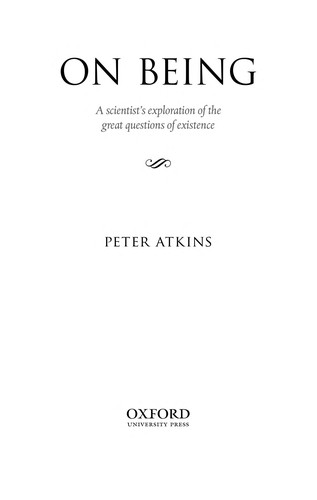
On Being: A Scientist's Exploration of the Great Questions of Existence
Sign in to keep track of books you’ve read and want to read.
Peter Atkins is the shining exception to the rule that scientists make poor writers. A Fellow at Oxford and a leading chemist, he has won admiration for his precise, lucid, and yet rigorous explanations of science. Now he turns to the greatest—and most controversial—questions of human existence. Can the scientific method tell us anything of value about birth, death, the origin of reality—and its end? Are these questions best left to faith?
Read more
In On Being, Atkins makes a provocative contribution to the great debate between religion and science. Atkins makes his position clear from the very first sentence: "The scientific method can shed light on every and any concept, even those that have troubled humans since the earliest stirrings of consciousness," he writes. He takes a materialist approach to the great questions of being that have inspired myth and religion, seeking to "dispel their mystery without diminishing their grandeur." In placing scientific knowledge in such cosmic perspective, he takes us on an often dizzying tour of existence. For example, he argues that "the substrate of existence is nothing at all." The total electrical charge of the universe, among other things, must be nothing—zero—he writes, or else the universe would have blasted itself apart. "Charge was not created at the creation: electrical Nothing separated into equal and opposite charges." He explores breathtaking questions—asking the purpose of the universe—with wit and learning, touching on Sanskrit scriptures and John Updike along the way.
"If absolutely and unreservedly everything is an aspect of the physical, material world, then I do not see how it can be closed to scientific investigation," Atkins writes. "The scientific method is the only means of discovering the nature of reality."
Liked On Being: A Scientist's Exploration of the Great Questions of Existence? Here’s where I’d start.
These suit anyone who liked On Being: A Scientist's Exploration of the Great Questions of Existence. Sign in and mark a few books for picks shaped around your own taste.
-
Infinite Potential: What Quantum Physics Reveals About How We Should Live Shares science, philosophy, nonfiction
-
 Adding a Dimension: Seventeen Essays on the History of Science Shares science, nonfiction
 -
 Just A Theory: Exploring The Nature Of Science Shares science, philosophy, nonfiction
 -
 Toward the Light of Liberty: The Struggles for Freedom and Rights That Made the Modern Western World Shares philosophy, nonfiction