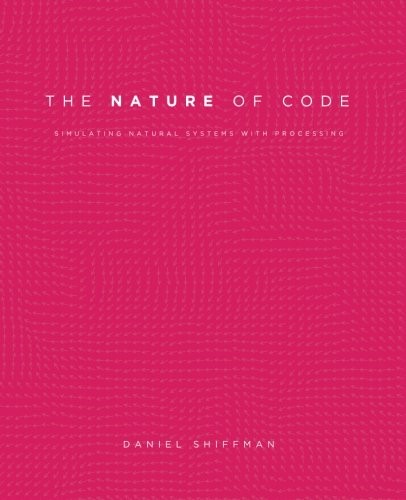
The Nature of Code
Sign in to keep track of books you’ve read and want to read.
How can we capture the unpredictable evolutionary and emergent properties of nature in software? How can understanding the mathematical principles behind our physical world help us to create digital worlds? This book focuses on a range of programming strategies and techniques behind computer simulations of natural systems, from elementary concepts in mathematics and physics to more advanced algorithms that enable sophisticated visual results. Readers will progress from building a basic physics engine to creating intelligent moving objects and complex systems, setting the foundation for further experiments in generative design. Subjects covered include forces, trigonometry, fractals, cellular automata, self-organization, and genetic algorithms. The book's examples are written in Processing, an open-source language and development environment built on top of the Java programming language. On the book's website (http://www.natureofcode.com), the examples run in the browser via Processing's JavaScript mode.
Liked The Nature of Code? Here’s where I’d start.
These suit anyone who liked The Nature of Code. Sign in and mark a few books for picks shaped around your own taste.
-
 Getting Started with Processing Shares processing, code, technology
 -
 Generative Design: Visualize, Program, and Create with Processing Shares programming, creative coding, computer science
 -
 The Practice of Programming (Addison-Wesley Professional Computing Series) Shares programming, computer science, tech
 -
 The Computational Beauty of Nature - Computer Explorations of Fractals, Chaos, Complex Systems & Adaption (Paper) (Bradford Books) Shares programming, computer science, science