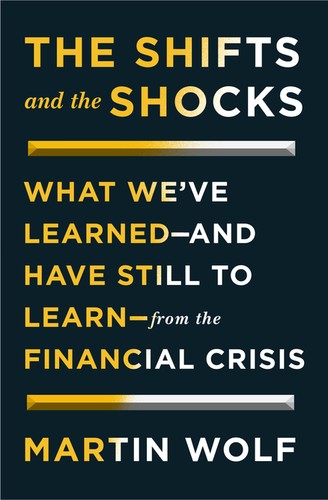
The Shifts and the Shocks: How the Financial Crisis Has Changed Our Future
Sign in to keep track of books you’ve read and want to read.
From the chief economic commentator for theFinancial Times, a brilliant tour d'horizon of the new global economy and its trajectory
Read more
We have been inundated with books about the "financial crisis." Surely, there is little more to be said. Martin Wolf agrees. In fact, he argues, too much has been said about the purely financial aspects of the crisis, important though they are. The underlying problem is that the world economy is unable to cope with the major shifts it is undergoing: rapid economic integration, competition from billions of new workers, technological revolutions, and the floods of capital across the world. These shifts have transformed relationships among economies and within them, creating new competitors, huge imbalances, and huge increases in inequality.
With those shifts have come vast and largely unforeseen financial shocks. The breakdown of the financial system in the high-income countries of the West was a symptom of unsuccessful, incomplete, and misguided adjustments to the imbalances created by this new world. The shocks are partly the result of the financial system's frailties, which must be remedied durably and radically. But they are also the consequence of deeper economic forces. To focus only on the financial breakdown is to mistake symptoms with causes. As important as improving the financial system is making the global economic system more stable.
The Shifts and the Shocksis the tour d'horizonof the new world economy that only Martin Wolf could write. It cements his status as among our most farseeing and imaginative economic commentators. Wolf makes us see how partial and confused our view of the economic events of the last five years has been. No other book offers such a thoroughly global perspective, nor one that understands the connection between the macroeconomics and the financial system with Wolf's level of sophistication and insight. It is not a book for those looking for a cheerful prognosis on the future of the European Union, or any number of other vital issues hanging fire, and it offers solutions that will seem extremely radical to some, but neither is it without hope.
The new global economic order is lifting tens of millions of people out of poverty and creating new winners and losers at an unimagined scale and pace. It's simply high time, indeed past time, for our economics to keep pace with our economy. Now, with The Shifts and the Shocks, it has.
Liked The Shifts and the Shocks: How the Financial Crisis Has Changed Our Future? Here’s where I’d start.
These suit anyone who liked The Shifts and the Shocks: How the Financial Crisis Has Changed Our Future. Sign in and mark a few books for picks shaped around your own taste.
-
 Fragile by Design: The Political Origins of Banking Crises and Scarce Credit Shares economics, finance, nonfiction
 -
 House of Debt: How They (and You) Caused the Great Recession, and How We Can Prevent It from Happening Again Shares economics, finance, nonfiction
 -
 The Bankers' New Clothes - What's Wrong with Banking and What to Do about It Shares economics, finance, nonfiction
 -
 When the Money Runs Out: The End of Western Affluence Shares economics, nonfiction, business
“People who read The Shifts and the Shocks: How the Financial Crisis Has Changed Our Future tend to reach for these next.”
-
 Hall of Mirrors: The Great Depression, the Great Recession, and the Uses - and Misuses - of History
-
 The Great Rebalancing: Trade, Conflict, and the Perilous Road Ahead for the World Economy
-
 Other People's Money: The Real Business of Finance
-
 After the Music Stopped: The Financial Crisis, the Response, and the Work Ahead