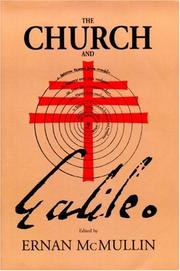
Galileo and the church
Sign in to keep track of books you’ve read and want to read.
This book questions the traditional "grand narratives" of science and religion in the seventeenth century. The binary oppositions underlying the story - between reason and faith, between knowledge and authority, between Scripture and the light of nature - have moulded it into a formative myth: the banner of modern rationalism, liberalism, and individualism.
Read more
While deconstructing the oppositions behind the conflict, the book offers an analysis of the complex intellectual/institutional field in which the drama of Galileo and the Church unfolded.
The well-known contradictions among the documents of Galileo's trials are reread as expressions of the contradictory nature of the Counter-Reformation church. A flashback into the formative years of Tridentine Catholicism demystifies its monolithic and brutally coercive tendencies. Rather, the church appears to have been torn between different cultural orientations and divided institutionally as well as theologically.
The traditional intellectual elite of the Dominicans adopted an orthodox Thomist allegiance and refused innovation in the name of Thomist rationalism. Their reaction to the challenge raised by the Counter-Reformation consisted in dogmatic Thomism. The Jesuits reacted to the same challenge by developing their vocation as educators of the entire Catholic society. In that role they reconstructed the Thomist synthesis by assimilating new scientific contents and reinterpreting its theology.
Theirs was a pragmatic Thomism. Galileo's Copernicanism emerged in the periphery of the cultural field newly organised by the Jesuits. The dispute on sunspots that took place between Galileo and the Jesuit astronomer Christopher Scheiner is the occasion signaling the emergence of a new discourse out of the Galileo-Jesuit dialogue.
The act of silencing exemplified in the trials of Galileo is in no need of demonstration. It has been so imprinted in our consciousness that to reassert it is to state the obvious. The author's story is not about the repression of truth by religious authority. It is the story of an encounter between different types of power-knowledge structures within the framework of a dialogical model.
Liked Galileo and the church? Here’s where I’d start.
These suit anyone who liked Galileo and the church. Sign in and mark a few books for picks shaped around your own taste.
-
 Church and society in eighteenth-century France Shares church history, catholic church, religion
-
History of the Bhil Catholic Church Shares church history, catholic church, religion
-
 A concise history of the Catholic Church Shares church history, catholic church, history
-
 Hunted heretic; the life and death of Michael Servetus, 1511-1553 Shares religion and science, church history, history