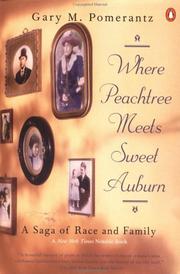
Where Peachtree meets Sweet Auburn
Sign in to keep track of books you’ve read and want to read.
There is an intersection in Atlanta where two worlds meet; where the architecture changes dramatically, the texture of the buildings reflecting two histories, separate and distinct. It is a crossing of two boulevards for dreamers in the South, white and black.
Read more
On the one hand, there are the gleaming sky scrapers of Peachtree, the street where Gone With the Wind author Margaret Mitchell once lived and later met her tragic death; and on the other, there are the Reconstruction-era churches of Auburn Avenue, where Dr. Martin Luther King, Jr., once preached and where his bier is now entombed inside a crypt with the epitaph "Free at Last, Free at Last, Thank God Almighty I'm Free at Last." The contrast between these streets hearkens to a time when boundaries were imposed by law, by segregation; this roughing of borders provides lingering evidence of a history and a city only recently joined.
Where Peachtree Meets Sweet Auburn explores the social, political and spiritual growth of this city and defines its racial conscience. It is the biography of Atlanta as told through two of its most prominent and elite families - one white, one black - as they ascend over five generations on opposite sides of a segregated city to produce the two most controversial mayors of the New South: Ivan Allen, Jr., and Maynard Jackson.
.
This is a story about family, race relations and the evolving South. Gary M. Pomerantz explores Atlanta's transformation - from its founding as the railroad center Terminus in 1837 to the ashes left by Gen. William T. Sherman's Union troops in 1864 to its role as center of the civil rights movement during the 1960s to its selection as the site of the 1996 Summer Olympics. Atlanta's history represents one of the most stark, dramatic examples of racial interdependence of any American city.
The Allens and the Dobbses, two Southern families who have lived in Atlanta for nearly a century, offer a vehicle to understand the rise of Atlanta as the definitive symbol of the New South. Both families contributed to this great work, providing hours of interviews during the past five years and aiding the research with exclusive letters, journals and photographs that date to the Civil War, when the Allens were aristocratic slave-holding members of the Confederacy in east Tennessee and the Dobbses were slaves in north Georgia.
Their worlds were shattered by the Civil War and their families' fortunes took flight at the turn of the century when patriarchs Ivan Allen, Sr., and John Wesley Dobbs arrived in a bustling, rebuilt Atlanta.
Liked Where Peachtree meets Sweet Auburn? Here’s where I’d start.
These suit anyone who liked Where Peachtree meets Sweet Auburn. Sign in and mark a few books for picks shaped around your own taste.