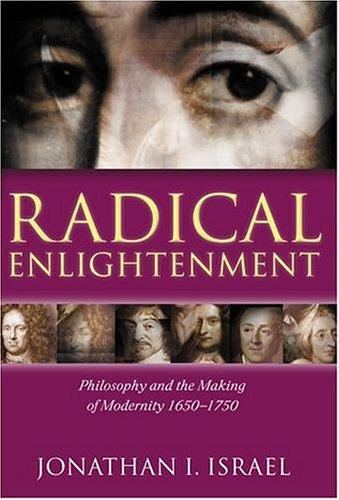
Radical Enlightenment: Philosophy and the Making of Modernity 1650-1750
Sign in to keep track of books you’ve read and want to read.
In the wake of the Scientific Revolution, the late seventeenth and eighteenth centuries saw the complete demolition of traditional structures of authority, scientific thought, and belief by the new philosophy and the philosophers, including Voltaire, Diderot, and Rousseau. The Radical Enlightenment played a part in this revolutionary process, which effectively overthrew all justification for monarchy, aristocracy, and ecclesiastical power, as well as man's dominance over woman, theological dominance of education, and slavery. Despite the present day interest in the revolutions of the eighteenth century, the origins and rise of the Radical Enlightenment have received limited scholarly attention. The greatest obstacle to the movement finding its proper place in modern historical writing is its international scope: the Racial Enlightenment was not French, British, German, Italian, Jewish or Dutch, but all of these at the same time.
In this wide-ranging volume, Jonathan Israel offers a novel interpretation of the Radical Enlightenment down to La Mettie and Diderot, two of its key exponents. Particular emphasis is placed on the pivotal role of Spinoza and the widespread underground international philosophical movement known before 1750 as Spinozism.
Liked Radical Enlightenment: Philosophy and the Making of Modernity 1650-1750? Here’s where I’d start.
These suit anyone who liked Radical Enlightenment: Philosophy and the Making of Modernity 1650-1750. Sign in and mark a few books for picks shaped around your own taste.
-
 The Philosophy of the Enlightenment Shares philosophy, enlightenment, history of ideas
 -
 The Enlightenment: The Rise of Modern Paganism Shares philosophy, enlightenment, history
 -
 The Enlightenment: And Why It Still Matters Shares philosophy, history, nonfiction
 -
 The Age of Enlightenment: The Eighteenth Century Philosophers Shares philosophy, enlightenment, history