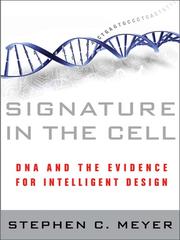
God, the Devil, and Darwin: A Critique of Intelligent Design Theory
Sign in to keep track of books you’ve read and want to read.
In the last fifteen years a controversial new theory of the origins of biological complexity and the nature of the universe has been fomenting bitter debates in education and science policy across North America, Europe, and Australia. Backed by intellectuals at respectable universities, Intelligent Design Theory(ID) proposes an alternative to accepted accounts of evolutionary theory: that life is so complex, and that the universe is so fine-tuned for the appearance of life, that the only plausible explanation is the existence of an intelligent designer. For many ID theorists, the designer is taken to be the god of Christianity.
Read more
Niall Shanks has written the first accessible introduction to, and critique of, this controversial new intellectual movement. Shanks locates the growth of ID in the last two decades of the twentieth century in the growing influence of the American religious right. But as he shows, its roots go back beyond Aquinas to Ancient Greece. After looking at the historical roots of ID, Shanks takes a hard look at its intellectual underpinnings, discussing modern understandings of thermodynamics, and how self-organizing processes lead to complex physical, chemical, and biological systems. He considers cosmological arguments for ID rooted in so-called "anthropic coincidences" and also tackles new biochemical arguments for ID based on "irreducible biological complexity." Throughout he shows how arguments for ID lack cohesion, rest on errors and unfounded suppositions, and generally are grossly inferior to evolutionary explanations.
While ID has been proposed as a scientific alternative to evolutionary biology, Shanks argues that ID is in fact "old creationist wine in new designer label bottles" and moreover is a serious threat to the scientific and democratic values that are our cultural and intellectual inheritance from the Enlightenment.
Liked God, the Devil, and Darwin: A Critique of Intelligent Design Theory? Here’s where I’d start.
These suit anyone who liked God, the Devil, and Darwin: A Critique of Intelligent Design Theory. Sign in and mark a few books for picks shaped around your own taste.
-
 The Counter-Creationism Handbook Shares science, evolution, atheism
 -
 Why Darwin Matters: The Case Against Intelligent Design Shares science, evolution, nonfiction
 -
 Creationism's Trojan Horse: The Wedge of Intelligent Design Shares science, evolution, religion
 -
 Evolution vs. Creationism: An Introduction Shares science, evolution, nonfiction