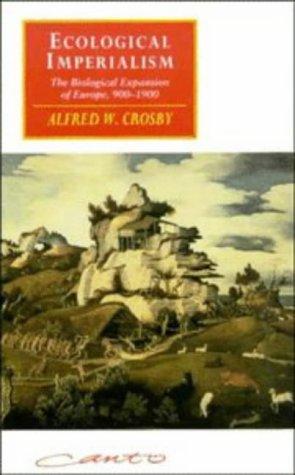
Ecological Imperialism: The Biological Expansion of Europe, 900-1900
Sign in to keep track of books you’ve read and want to read.
People of European descent form the bulk of the population in most of the temperate zones of the world—North America, Australia and New Zealand. The military successes of European imperialism are easy to explain because in many cases they were achieved by using firearms against spears. Alfred Crosby, however, explains that the Europeans' displacement and replacement of the native peoples in the temperate zones was more a matter of biology than of military conquest. Now in a new edition with a new preface, Crosby revisits his classic work and again evaluates the ecological reasons for European expansion. Alfred W. Crosby is the author of the widely popular and ground-breaking books, The Measure of Reality (Cambridge, 1996), and America's Forgotten Pandemic (Cambridge, 1990). His books have received the Ralph Waldo Emerson Prize, the Medical Writers Association Prize and been named by the Los Angeles Times as among the best books of the year. He taught at the University of Texas, Austin for over 20 years. First Edition Hb (1986): 0-521-32009-7 First Edition Pb (1987): 0-521-33613-9
Liked Ecological Imperialism: The Biological Expansion of Europe, 900-1900? Here’s where I’d start.
These suit anyone who liked Ecological Imperialism: The Biological Expansion of Europe, 900-1900. Sign in and mark a few books for picks shaped around your own taste.
-
 Changes in the Land: Indians, Colonists, and the Ecology of New England Shares history, environmental history, nonfiction
 -
 Down to Earth: Nature's Role in American History Shares history, environmental history, nonfiction
 -
 Dust Bowl: The Southern Plains in the 1930s Shares history, environmental history, nonfiction
 -
 Creatures of Empire: How Domestic Animals Transformed Early America Shares history, environmental history, nonfiction
“People who read Ecological Imperialism: The Biological Expansion of Europe, 900-1900 tend to reach for these next.”
-
 The Middle Ground: Indians, Empires, and Republics in the Great Lakes Region, 1650-1815 (Studies in North American Indian History)
-
 Before European Hegemony: The World System AD 1250-1350
-
 The Ecological Indian: Myth and History
-
 Something New Under the Sun: An Environmental History of the Twentieth-Century World