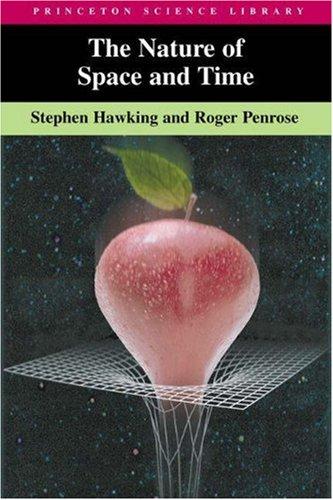
The Nature of Space and Time
Sign in to keep track of books you’ve read and want to read.
Contents
Foreword by Sir Michael Francis Atiyah, OM, FRS, FRSE, FMedSci FAA, HonFREng
Read more
Lecture 1 - Classical Theory {Hawking}
Lecture 2 - Structure of Spacetime Singularities {Penrose}
Lecture 3 - Quantum Black Holes {Hawking}
Lecture 4 - Quantum Theory and Spacetime {Penrose}
Lecture 5 - Quantum Cosmology {Hawking}
Lecture 6 - The Twistor View of Spacetime {Penrose}
Chapter 7 - The Debate {Hawking and Penrose}
Einstein said that the most incomprehensible thing about the universe is that it is comprehensible. But was he right? Can the quantum theory of fields and Einstein's general theory of relativity, the two most accurate and successful theories in all of physics, be united in a single quantum theory of gravity? Can quantum and cosmos ever be combined? On this issue, two of the world's most famous physicists—Stephen Hawking ("A Brief History of Time") and Roger Penrose ("The Emperor's New Mind" and "Shadows of the Mind")—disagree. Here they explain their positions in a work based on six lectures with a final debate, all originally presented at the Isaac Newton Institute for Mathematical Sciences at the University of Cambridge.
How could quantum gravity, a theory that could explain the earlier moments of the big bang and the physics of the enigmatic objects known as black holes, be constructed? Why does our patch of the universe look just as Einstein predicted, with no hint of quantum effects in sight? What strange quantum processes can cause black holes to evaporate, and what happens to all the information that they swallow? Why does time go forward, not backward?
In this book, the two opponents touch on all these questions. Penrose, like Einstein, refuses to believe that quantum mechanics is a final theory. Hawking thinks otherwise, and argues that general relativity simply cannot account for how the universe began. Only a quantum theory of gravity, coupled with the no-boundary hypothesis, can ever hope to explain adequately what little we can observe about our universe. Penrose, playing the realist to Hawking's positivist, thinks that the universe is unbounded and will expand forever. The universe can be understood, he argues, in terms of the geometry of light cones, the compression and distortion of spacetime, and by the use of twistor theory. With the final debate, the reader will come to realize how much Hawking and Penrose diverge in their opinions of the ultimate quest to combine quantum mechanics and relativity, and how differently they have tried to comprehend the incomprehensible.
Liked The Nature of Space and Time? Here’s where I’d start.
These suit anyone who liked The Nature of Space and Time. Sign in and mark a few books for picks shaped around your own taste.
-
 Once Before Time: A Whole Story of the Universe Shares physics, science, cosmology
 -
 Beyond Einstein: The Cosmic Quest for the Theory of the Universe Shares physics, science, nonfiction
 -
 Hiding in the Mirror: The Mysterious Allure of Extra Dimensions, from Plato to String Theory and Beyond Shares physics, science, nonfiction
 -
 The Infinity Puzzle: Quantum Field Theory and the Hunt for an Orderly Universe Shares physics, science, nonfiction