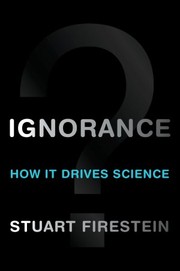
Ignorance: (On the Wider Implications of Deficient Knowledge)
Sign in to keep track of books you’ve read and want to read.
Historically, there has been great deliberation about the limits of human knowledge. Isaac Newton, recognizing his own shortcomings, once described himself as "a boy standing on the seashore . . . whilst the great ocean of truth lay all underscored before me."
Read more
In Ignorance,Nicholas Rescher presents a broad-ranging study that examines the manifestations, consequences, and occasional benefits of ignorance in areas of philosophy, scientific endeavor, and ordinary life. Citing philosophers, theologians, and scientists from Socrates to Steven Hawking, Rescher seeks to uncover the factors that hinder our cognition.
Rescher categorizes ignorance as ontologically grounded (rooted in acts of nature-erasure, chaos, and chance-that prevent fact determination), or epistemically grounded (the inadequacy of our information-securing resources). He then defines the basis of ignorance: inaccessible data; statistical fogs; secreted information; past data that have left no trace; future discoveries; future contingencies; vagrant predicates; and superior intelligences. Such impediments set limits to inquiry and mean that while we can always extend our existing knowledge-variability here is infinite-there are things that we will never know.
Cognitive finitude also hinders our ability to assimilate more than a certain number of facts. We may acquire additional information, but lack the facility to interpret it. More information does not always increase knowledge; it may point us further down the path toward an erroneous conclusion. In light of these deficiencies, Rescher looks to the role of computers in solving problems and expanding our knowledge base, but finds limits to their reasoning capacity.
As Rescher's comprehensive study concludes, ignorance itself is a fertile topic for knowledge, and recognizing the boundaries of our comprehension is where wisdom begins.
Liked Ignorance: (On the Wider Implications of Deficient Knowledge)? Here’s where I’d start.
These suit anyone who liked Ignorance: (On the Wider Implications of Deficient Knowledge). Sign in and mark a few books for picks shaped around your own taste.
-
 Psychology and epistemology Shares theory of, theory of knowledge, cognition
-
 Pramāṇapaddhati Shares theory of, theory of knowledge
-
 The Women's Movement and Women's Employment in Nineteenth Century Britain Shares women, labor, business economics
-
 NECESSARY KNOWLEDGE Shares theory of, theory of knowledge, cognition