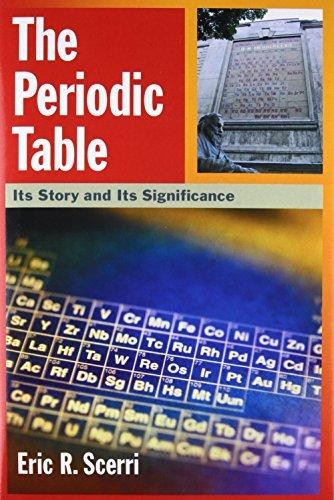
The Periodic Table: Its Story and Its Significance
Sign in to keep track of books you’ve read and want to read.
The periodic table is one of the most potent icons in science. It lies at the core of chemistry and embodies the most fundamental principles of the field. The one definitive text on the development of the periodic table by van Spronsen (1969), has been out of print for a considerable time. The present book provides a successor to van Spronsen, but goes further in giving an evaluation of the extent to which modern physics has, or has not, explained the periodic system. The book is written in a lively style to appeal to experts and interested lay-persons alike.
Read more
The Periodic Tablebegins with an overview of the importance of the periodic table and of the elements and it examines the manner in which the term 'element' has been interpreted by chemists and philosophers. The book then turns to a systematic account of the early developments that led to the classification of the elements including the work of Lavoisier, Boyle and Dalton and Cannizzaro. The precursors to the periodic system, like Dobereiner and Gmelin, are discussed. In chapter 3 the discovery of the periodic system by six independent scientists is examined in detail.
Two chapters are devoted to the discoveries of Mendeleev, the leading discoverer, including his predictions of new elements and his accommodation of already existing elements. Chapters 6 and 7 consider the impact of physics including the discoveries of radioactivity and isotopy and successive theories of the electron including Bohr's quantum theoretical approach. Chapter 8 discusses the response to the new physical theories by chemists such as Lewis and Bury who were able to draw on detailed chemical knowledge to correct some of the early electronic configurations published by Bohr and others.
Chapter 9 provides a critical analysis of the extent to which modern quantum mechanics is, or is not, able to explain the periodic system from first principles. Finally, chapter 10 considers the way that the elements evolved following the Big Bang and in the interior of stars. The book closes with an examination of further chemical aspects including lesser known trends within the periodic system such as the knight's move relationship and secondary periodicity, as well at attempts to explain such trends.
Liked The Periodic Table: Its Story and Its Significance? Here’s where I’d start.
These suit anyone who liked The Periodic Table: Its Story and Its Significance. Sign in and mark a few books for picks shaped around your own taste.
-
 Nature's Building Blocks: An A-Z Guide to the Elements Shares science, chemistry, nonfiction
 -
 Cathedrals of Science: The Personalities and Rivalries That Made Modern Chemistry Shares science, chemistry, nonfiction
 -
 The Search for the Elements Shares chemistry, science, nonfiction
 -
 A Guide to the Elements Shares chemistry, science, nonfiction