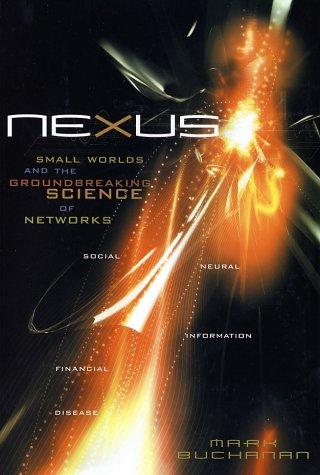
Nexus: Small Worlds and the Groundbreaking Theory of Networks
Sign in to keep track of books you’ve read and want to read.
"If you ever wanted to know how many links connect you and the Pope, or why when the U.S. Federal Reserve Bank sneezes the global economy catches cold, read this book," writes John L. Casti (Santa Fe Institute). This "cogent and engaging" (Nature) work presents the fundamental principles of the emerging field of "small-worlds" theory—the idea that a hidden pattern is the key to how networks interact and exchange information, whether that network is the information highway or the firing of neurons in the brain. Mathematicians, physicists, computer scientists, and social scientists are working to decipher this complex organizational system, for it may yield a blueprint of dynamic interactions within our physical as well as social worlds.
Read more
Highlighting groundbreaking research behind network theory, "Mark Buchanan's graceful, lucid, nontechnical and entertaining prose" (Mark Granovetter) documents the mounting support among various disciplines for the small-worlds idea and demonstrates its practical applications to diverse problems—from the volatile global economy or the Human Genome Project to the spread of infectious disease or ecological damage. Nexusis an exciting introduction to the hidden geometry that weaves our lives so inextricably together.
Liked Nexus: Small Worlds and the Groundbreaking Theory of Networks? Here’s where I’d start.
These suit anyone who liked Nexus: Small Worlds and the Groundbreaking Theory of Networks. Sign in and mark a few books for picks shaped around your own taste.
-
 Six Degrees: The Science of a Connected Age Shares science, networks, complexity
 -
 Linked: How Everything Is Connected to Everything Else and What It Means for Business, Science, and Everyday Life Shares science, complexity, nonfiction
 -
 Sync: The Emerging Science of Spontaneous Order Shares science, complexity, nonfiction
 -
 Complexity: Life at the Edge of Chaos Shares science, complexity, complex systems